
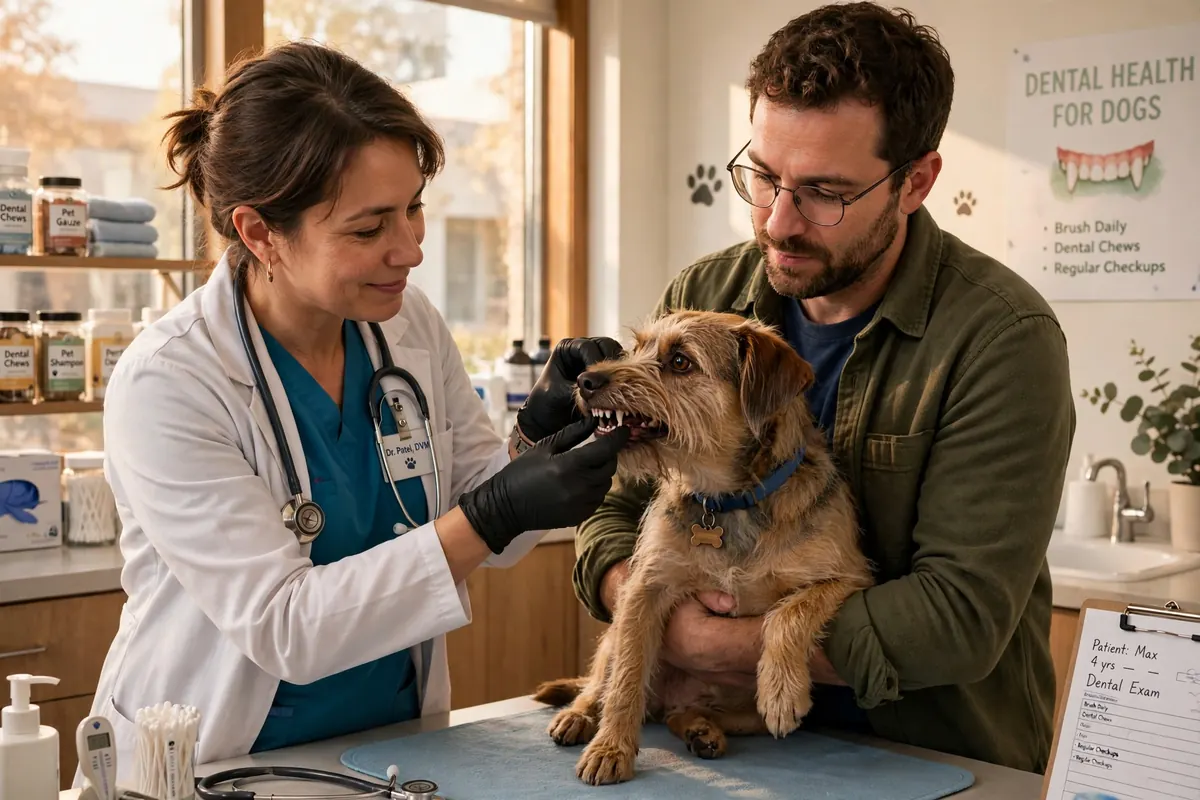
Pet dental insurance pays for dental illness and dental accidents inside a normal accident and illness plan, from gum disease to a broken tooth. Routine cleaning is not in the base plan. It comes only through a wellness add on that pays a set amount toward one cleaning a year.
Bad breath is easy to ignore. A $1,200 vet bill for a broken tooth is not. Dental problems are the most common health issue in dogs and cats, and they are also where pet insurance confuses people the most. Owners buy a plan, book a teeth cleaning, and then learn the plan pays nothing toward it.
This guide explains pet dental insurance in plain words: what it really is, what it pays for, what it skips, and which brands handle teeth best. Dogs get their share of dental trouble — cracked teeth from hard chews, and gum disease that creeps in quietly. Cats get gum disease too, plus a painful condition that slowly eats away at their teeth. We cover both, with real prices and the fine print most sites leave out.
Pet dental insurance, in 20 seconds: There is no true dental-only pet policy in the US. “Dental cover” means two things working together: an accident and illness plan that pays when teeth get hurt or diseased, and an optional wellness add-on that pays a set amount toward routine cleanings. Buy the plan for the big dental bills — extractions and gum disease treatment. Treat the cleaning benefit as a small bonus, not the main event.
Key Takeaways
- There is no standalone dental-only pet insurance in the US. Dental cover lives inside normal accident and illness plans, plus wellness add-ons.
- Routine cleanings are never in the base plan. A wellness add-on pays a set amount — usually $100 to $150 a year — toward one cleaning.
- Extractions are covered when the cause is covered: a tooth broken in an accident, or a tooth ruined by a covered illness. Cosmetic work and teeth that were already bad before you enrolled are not covered.
- Fine print decides claims. Embrace caps dental illness at $1,000 a year. Pets Best asks older pets for a recent cleaning before it covers gum disease. Trupanion wants a dental exam on file every year.
- By age 3, about 80% of dogs and 70% of cats already show signs of gum disease (AVMA). Enrolling young, before the vet writes “periodontal disease” in the chart, is the single best move you can make.

What is pet dental insurance, really?
When people search for pet dental insurance, most picture a plan that only covers teeth — like the dental plan you get through a job. That product does not exist for pets in the US. No insurer sells a teeth-only policy for dogs or cats.
Instead, dental cover comes in two pieces:
- Piece one: an accident and illness plan. This is the main policy. It pays when something goes wrong with the teeth — a fracture, an abscess, gum disease, a tumor — as long as the plan includes dental illness and the problem started after you enrolled. If you are new to how these plans pay out, our guide to how pet insurance works walks through the claim steps.
- Piece two: a wellness add-on. This is an extra you bolt onto the main plan for a few dollars a month. It pays fixed amounts toward planned care, including one dental cleaning a year.
That split explains almost every angry review you will ever read. The owner expected piece two. Their plan only had piece one. Both pieces are useful — but they pay for very different things, and the rest of this guide keeps them separate.
Can you get dental-only pet insurance?
Short answer: no. There is no dental-only pet insurance policy in the US today, from any brand we checked. If a site tries to sell you “dental insurance for pets” as its own product, it is almost always one of these three things in disguise:
- A normal accident and illness plan with good dental cover inside it (the brands in the table below).
- A wellness plan or membership that helps with routine care like cleanings, but pays nothing if your pet gets sick or hurt (more on store memberships further down).
- A discount plan, which knocks a percentage off vet bills but is not insurance and has no claim payouts.
The closest real routes to “dental-only” cover are: pick an accident and illness plan with strong dental illness cover, or add a wellness add-on for cleanings — or do both. That is as close as the US market gets, and honestly, it covers more than a teeth-only policy would.
Does pet dental insurance cover dental cleaning?
This is the question that starts most dental claim fights, so here is the clean split:
Routine cleaning — the yearly scale and polish your vet recommends — is planned care. Base plans do not pay for it. Not one brand in our table includes it free. The only way insurance money touches a routine cleaning is a wellness add-on, and the amounts are modest: $100 a year on the basic ASPCA and Spot tiers, $150 a year on their top tiers, $150 on MetLife’s Preventive Care, and $150 on Pets Best’s BestWellness. A real cleaning with anesthesia often costs $375 or more, so the add-on softens the bill. It does not erase it.
Treatment cleaning is different. Sometimes a vet prescribes a deep cleaning as part of treating a dental illness — to clean under the gumline where the disease lives. Prudent Pet, one of the smaller insurers, spells this rule out on its own site: if an extraction is found necessary during a routine cleaning, the extraction may be covered even though the cleaning is not — and if a cleaning is done as part of treating a covered condition, both may be covered. ASPCA’s Complete Coverage can also pay for a cleaning prescribed to treat a covered dental illness. Same chair, same tools, different reason — and the reason is what gets paid.
So the honest answer to “does pet insurance cover dental cleaning?” is: routine cleaning, only through a wellness add-on; cleaning done to treat a covered illness, often yes. Ask which one your vet is booking before the appointment, not after the bill.
Does it cover extractions?
Usually, yes — extractions are where dental cover earns its money. A tooth comes out for one of three reasons, and cover follows the reason:
- Accident: your dog cracks a tooth on an antler or a rock, or takes a blow to the jaw. Nearly every accident and illness plan covers the extraction, and cheap accident-only plans cover it too. Healthy Paws, which skips dental illness entirely, still covers extractions and reconstruction for teeth hurt in accidents.
- Illness: gum disease, an abscess, or tooth resorption ruins the tooth. Plans that include dental illness cover the extraction after your deductible — this is the most common big dental claim there is.
- Not covered: teeth that were already diseased before you enrolled, cosmetic work, and baby teeth in most plans (a few, like Trupanion and Fetch, cover retained baby teeth in set cases).
Real numbers help here. MetLife publishes a claim from a small senior dog in Virginia who fractured a tooth on a bone: the extraction bill came to over $1,200, and the plan paid back about $1,100. Fetch publishes a periodontal disease case that cost $6,126, of which Fetch paid $4,417. One bad tooth can cost more than a year of premiums. Ten bad teeth can cost more than a car repair.
Which brands cover what? The dental comparison table
We checked each brand’s own pages and policy materials — not roundup sites — for the four questions below. Where brands told different stories in different places, the notes in our research file say so.
| Brand | Dental illness in base plan? | Dental accidents? | Routine cleaning | Watch out for |
|---|---|---|---|---|
| ASPCA | Yes — Complete Coverage includes dental disease | Yes | Wellness add-on ($100 Basic / $150 Prime per year) | The Accident-Only plan skips dental illness |
| Spot | Yes | Yes | Preventive add-on (Gold $100 / Platinum $150 per year) | The cleaning benefit is a fixed amount, not the full bill |
| Embrace | Yes, but capped at $1,000 per policy term | Yes | Wellness Rewards add-on | The $1,000 dental illness cap is the tightest here |
| Fetch | Yes — every adult tooth, incl. root canals and crowns | Yes | Fetch Wellness add-on only | Formerly called Petplan — same company, new name |
| Lemonade | Add-on only (dental riders) | Yes, in the base plan | Dental Care rider, or Preventive+ (up to $150/yr) | Riders cap dental at $1,000/yr and vary by state |
| Trupanion | Yes | Yes | Never — no wellness plan is sold | Keep a dental exam on file every year and follow your vet’s cleaning advice |
| Healthy Paws | No — accidents only | Yes, incl. extractions and reconstruction | Never — no wellness add-on | Gum disease and other dental illness are not covered |
| Pumpkin | Yes | Yes | Separate Wellness Club plans only — not the Preventive Essentials add-on | No dental exam is required for dental illness cover — a real plus |
| MetLife | Yes — incl. periodontal disease, stomatitis, root canals | Yes | Preventive Care add-on ($150 toward cleaning) | Periodontal disease your pet already has is excluded — enroll early |
| Pets Best | Yes, with a condition (below) | Yes — even the accident-only plan covers dental fractures | BestWellness add-on ($150 per year) | Pets age 3+ need a cleaning under anesthesia within the last 13 months for periodontal cover |
| Nationwide | Whole Pet covers dental diseases; Major Medical pays set amounts for some dental conditions | Yes | Whole Pet with Wellness, or the Pet Wellness plan | Terms vary a lot by plan — check which Nationwide plan you are quoted |
One name note, because it confuses a lot of searchers: Petplan in the US rebranded to Fetch (Fetch by The Dodo, now Fetch Pet Insurance). Fetch says on its own site that only the name and logo changed. If you had a Petplan policy, you have a Fetch policy now — and “Petplan dental cover” means the Fetch row above.
So which is the best pet dental insurance?
There is no single winner, but the table points to clear picks by need:
- Best for cleaning: Spot or ASPCA — their top wellness tiers pay $150 a year toward a cleaning, the add-ons start at $9.95 a month, and the benefits start right away. MetLife’s Preventive Care matches the $150.
- Best for extractions and dental illness: Fetch — it covers disease in every adult tooth, including root canals and crowns, with no dental cap stated, and it publishes real paid claims. Trupanion is close behind if you keep up the yearly dental exam it asks for.
- Best for cats: Fetch again — it names tooth resorption, the big cat tooth problem, in its covered list, and cats are cheap to insure next to dogs.
- Best budget route: a Pets Best accident-only plan (advertised from $9 a month for dogs, $6 for cats) covers a broken-tooth extraction — just know it pays nothing for dental illness or cleanings.
Waiting periods: the dental catch nobody mentions
Every plan makes you wait before cover starts. Anything that shows up during the wait counts as pre-existing — forever. For dental, that rule bites hard, because gum disease is usually already growing silently when owners sign up.
The good news: almost no brand has a special extra wait just for teeth. Dental claims follow the normal accident and illness waits. The bad news: a few brands attach conditions to dental illness cover that work like a hidden waiting period. Here is the full picture:
| Brand | Accident wait | Illness wait | Dental note |
|---|---|---|---|
| MetLife | 0 days — starts at midnight | 14 days | Preventive add-on works from day one |
| Fetch | None | Up to 15 days | Wellness add-on has no wait |
| Embrace | 2 days | 14 days | Dental follows the same waits |
| Lemonade | 2 days | 14 days | Riders follow the base plan’s waits |
| Pets Best | 3 days (0 in some states) | 14 days | Wellness benefits start right away |
| Trupanion | 5 days | 30 days | Longest illness wait here — but no separate dental wait |
| ASPCA | 14 days | 14 days | Preventive benefits start when the plan starts |
| Spot | 14 days | 14 days | Some states shorten the accident wait |
| Pumpkin | 14 days | 14 days | One simple wait for everything |
| Healthy Paws | 15 days | 15 days | Only dental accidents are covered anyway |
| Nationwide | Varies by plan | Varies by plan | Not stated on its public pages — check your quote |
So, is there pet dental insurance with no waiting period? For dental illness, no — every brand makes you wait at least a few days, and 14 days is typical. The shortest paths are MetLife for accidents (cover starts at midnight) and Fetch, which has no accident wait at all. Wellness add-on benefits, on the other hand, often start immediately.
The conditions matter as much as the days. Trupanion covers dental illness only if your pet gets a dental exam every year and you follow the vet’s cleaning advice — skip a recommended cleaning, and a later claim can be denied. Pets Best covers periodontal disease for pets age 3 and up only if they have had a cleaning under anesthesia in the last 13 months with no gum disease found. Prudent Pet asks for a yearly exam and any recommended cleaning. Pumpkin asks for none of this. None of these rules are evil — but all of them surprise people at claim time.
Pre-existing conditions: why gum disease is the #1 denial
No pet insurer covers a condition your pet already had. For teeth, that one rule causes more pain than any other, because dental disease is progressive and it gets written down.
Here is how it plays out. At a checkup, the vet notes “Grade 2 dental disease” in the chart. You do nothing — the dog seems fine. A year later you buy insurance. Six months after that, the dog needs three teeth out, and the claim is denied: the disease was documented before the policy started. Prudent Pet states this flatly in its own materials: dental disease graded 2 or 3 before the policy is pre-existing, and because dental disease only moves one way, later stages trace back to it.
Three honest exceptions exist:
- Curable conditions can reset. ASPCA and Spot treat a condition as new again after 180 days with no symptoms or treatment. A one-off mouth infection that fully cleared can qualify. Chronic gum disease usually cannot — it does not truly clear without treatment.
- Lemonade’s Dental Care rider, in the states where it is offered, can cover pre-existing dental conditions for pets under 3 years old, within its $1,000 yearly cap. It is the only built-for-this exception we found — narrow, but real.
- A clean first exam protects you. If your pet’s first vet visit after enrolling shows healthy teeth, that record becomes your proof that later disease is new. This is the cheapest claim insurance you will ever buy, and it costs one exam.
Pet dental insurance for cats: resorption, stomatitis, and big bills
Cats hide mouth pain well. Many owners learn their cat has dental disease only when she stops eating or starts dropping kibble. Two cat-specific problems drive most feline dental claims:
- Tooth resorption. The tooth slowly dissolves from the inside. It is painful, it cannot be fixed with cleaning, and the cure is extraction. Fetch puts the scale of it plainly on its dental page: nearly 7 out of 10 cats will have tooth resorption in their lives. ASPCA, Fetch, Trupanion, and MetLife all list resorption or the extractions it needs in their covered care.
- Stomatitis. The cat’s immune system attacks her own mouth, causing severe, painful inflammation. When medicine fails, vets often recommend removing many teeth — sometimes all of them. Cats do surprisingly well without teeth, but the surgery is a big one: full-mouth extraction commonly runs $1,500 to $4,000 or more at a general practice.

The good news: the same plans in the table above cover cats, and cat plans cost much less than dog plans — about $435 a year on average for accident and illness cover. Our guide to the best pet insurance for cats compares the cat-friendly brands in full. If you adopt an adult cat, get her teeth checked and charted early. With cats, the medical record is the whole game.
What does pet dental insurance cost?
There are two costs to think about: what the cover costs, and what the vet charges without it.
The cover. Dental protection rides inside a normal plan, so the price is the plan price: accident and illness cover averages about $836 a year for a dog and $435 a year for a cat (NAPHIA figures from our pet insurance statistics page). Wellness add-ons are the extra: about $9.95 a month for basic tiers (ASPCA, Spot) and $24.95 a month for top tiers, with Pets Best’s BestWellness at roughly $26 to $33 a month.
The vet bills it protects you from. What dental care costs with no plan at all:
| Procedure | What owners typically pay |
|---|---|
| Professional cleaning, dog (with anesthesia) | Around $375–$390 on average (CareCredit); $300–$700 is common once X-rays and bloodwork are added |
| Professional cleaning, cat (with anesthesia) | Around $375–$430 on average (CareCredit) |
| One extraction, total bill | Often $500 or more once anesthesia and X-rays are counted; MetLife’s published fractured-tooth claim topped $1,200 |
| Periodontal disease treatment | $390–$2,600 (MoneyGeek vet-cost data) |
| Full-mouth extraction, cat | $1,500–$4,000 or more |
Looking for cheap pet dental insurance? The cheapest legitimate routes are narrower than the ads suggest. An accident-only plan from Pets Best starts at an advertised $9 a month for dogs and $6 for cats, and it will pay for a tooth broken in an accident — nothing else dental. A $9.95-a-month wellness add-on pays $100 toward a cleaning, but it is not insurance and pays nothing when teeth get sick. Both are fine tools. Neither is full dental cover, and any “cheap dental plan” that promises everything for a few dollars is selling one of these two in a costume.
Is pet dental insurance worth it? The honest math
Run the cleaning math first, because it surprises people. A basic wellness add-on costs about $119 a year and pays $100 toward a cleaning. The top tiers cost about $299 a year and pay $150. On cleaning alone, the add-on never pays for itself. It only wins if you also use most of its other benefits — the exam, vaccines, and tests on its list. Buy it as a bundle you will fully use, or skip it and save the premium.
The illness math is the opposite story. One periodontal treatment runs $390 to $2,600. One fractured tooth cost over $1,200 in MetLife’s published claim, and the plan returned about $1,100 of it. One Fetch periodontal case cost $6,126. Against an average of $836 a year for a dog plan — which also covers every other accident and illness, not just teeth — a single bad dental year can return several years of premiums. We run the same math for insurance as a whole in our guide on whether pet insurance is worth it.
The honest read: Buy the accident and illness plan for your pet’s overall health, and treat its dental illness cover as one of the most likely parts to ever pay out — teeth go wrong for almost every pet eventually. Add the wellness tier only if you will use most of its benefits every year. Skip both if your pet already has graded dental disease in their chart: the big dental claims will be denied as pre-existing, and you are better off putting the premium money into a savings jar for the extraction bill itself. Whatever you pick, compare full plan prices on our pet insurance cost hub before you decide.
Petco and PetSmart “dental” plans are not insurance
Two searches bring a lot of owners here, so let us clear them up kindly. Petco’s Vital Care is a paid membership, not insurance. Petco’s own launch announcement lists what it includes: unlimited vet exams at its Vetco clinics, unlimited nail trims and teeth brushing at the grooming salon, and store rewards. Teeth brushing by a groomer is a nice extra — but it is not a professional dental cleaning under anesthesia, and the membership does not pay vet bills when your pet gets sick or hurt.
PetSmart’s in-store vet, Banfield, sells Optimum Wellness Plans. Banfield itself calls these “preventive care packages” and says plainly on its site that, unlike insurance, there is no claims process — you are prepaying for a bundle of routine services. The Plus tiers (Active Care Plus, Senior Care Plus) do include a real professional dental cleaning, which makes them genuinely useful for cleaning costs. But they cover no accidents and no illnesses, and the care happens at Banfield. Membership for routine care, insurance for surprises: some owners happily carry both, but they are not the same thing.
Why owners feel caught out (and how not to be)
Read any forum thread about dental claims and the same three stories repeat. “I thought cleaning was covered” — it was not, because cleaning is routine care. “They called it pre-existing” — the vet had noted gum disease at a checkup before the policy began. “Nobody told me about the exam rule” — the plan needed a yearly dental exam or a recent cleaning on file, and the record was missing.
Every one of those denials follows the written rules. The rules just were not read. Before you buy any plan, ask these three questions — in writing, so the answer is on record:
- “Is dental illness in the base plan, an add-on, or capped?” (Embrace caps it at $1,000 a year. Lemonade sells it as a rider. Healthy Paws leaves it out.)
- “What must be in my pet’s record for a dental claim to pay?” (A yearly exam at Trupanion. A cleaning in the last 13 months at Pets Best. Nothing special at Pumpkin.)
- “What does the wellness add-on actually pay toward a cleaning — and what does it cost me per year?” If the second number is bigger than the first, know that you are buying the bundle, not a cleaning discount.
Ask those, keep every dental exam on file, and enroll while the chart is still clean. That is the whole secret. There is no other trick.
Frequently asked questions
What pet insurance covers dental cleaning?
No base plan covers routine dental cleaning. Cleaning money comes from wellness add-ons: ASPCA and Spot pay $100 a year on their basic tiers and $150 on their top tiers, MetLife’s Preventive Care pays $150, and Pets Best’s BestWellness pays $150. One exception: a cleaning your vet prescribes to treat a covered dental illness can be paid by the base plan itself.
Does pet insurance cover dental extractions?
Yes, when the reason is covered. If a tooth is broken in an accident, or ruined by a covered illness like gum disease, an abscess, or tooth resorption, most accident and illness plans pay for the extraction after your deductible. Extractions are not covered when the tooth was already diseased before you enrolled, or when the work is cosmetic.
Can you get pet dental insurance for pre-existing conditions?
No plan pays for dental disease your pet already has — that is the most common dental denial there is. There are two narrow exceptions. Curable conditions can count as new again after 180 days symptom-free with brands like ASPCA and Spot. And Lemonade’s Dental Care rider, in some states, can cover pre-existing dental conditions for pets under 3, within a $1,000 yearly cap.
Which pet insurance has no waiting period for dental?
None has zero wait for dental illness — 14 days is typical, and Trupanion asks 30. For dental accidents, MetLife starts cover at midnight after you enroll, and Fetch has no accident waiting period at all. Wellness add-on benefits often start right away: MetLife’s preventive cover and ASPCA’s preventive benefits can be used as soon as the plan is active.
Is there pet dental insurance for cats?
Yes — the same plans cover cats, and every brand in our table insures them. Cat dental cover matters because cats get tooth resorption (nearly 7 in 10 cats, by Fetch’s figures) and stomatitis, which can lead to full-mouth extractions costing $1,500 to $4,000 or more. Cat accident and illness plans average about $435 a year, much less than dog plans.
Which pet insurance covers dental cleaning and extractions?
You need both pieces together: an accident and illness plan that includes dental illness, plus its wellness add-on for routine cleanings. Spot, ASPCA, MetLife, and Pets Best all sell that pairing, with $100 to $150 a year toward cleaning and full cover for illness extractions. Nationwide’s Whole Pet with Wellness bundles both into one plan instead.
Is pet dental insurance worth it?
For illness cover, often yes: one periodontal treatment runs $390 to $2,600, and a single fractured-tooth claim has paid back about $1,100 — more than a year of average premiums. For cleaning alone, no: a wellness add-on costs $119 to $299 a year and pays only $100 to $150 toward cleaning, so it pays off only if you use most of its other benefits too.
Does pet insurance cover dental cleaning?
Only in two set cases. A wellness add-on pays a fixed $100 to $150 a year toward a routine cleaning — it helps, but a real cleaning with anesthesia often costs $375 or more. And if your vet prescribes a cleaning to treat a covered dental illness, the base plan itself may pay for it. A routine cleaning, on a base plan with no add-on, is never covered.
How we wrote this guide: every brand fact and price above was checked against the insurer’s own website, policy materials, or published benefit schedules in October 2026 — not copied from roundup sites. Where sources disagreed (and several did), we used the insurer’s own version and logged the conflict in our research notes. Plan terms vary by state and change over time, so confirm your exact policy wording before you rely on any single detail. Last updated: October 2026.
Sources
- MetLife Pet — Does Pet Insurance Cover Dental Costs?
- MetLife Pet — FAQs (dental coverage answer)
- MetLife Pet — Preventive Care benefit schedule
- MetLife Pet — Dog Tooth Extraction Cost (published claim example)
- Trupanion — When does my coverage start?
- Pumpkin — Pumpkin vs. Prudent Pet (dental exam requirements)
- Pumpkin — Wellness Club benefits definitions (professional dental cleaning)
- Spot Pet Insurance — preventive care benefit schedule
- Fetch Pet Insurance — Is Petplan now Fetch?
- Banfield Pet Hospital — Pet insurance vs. preventive care package
- Petco — Vital Care wellness plan announcement
- NerdWallet — Pet Dental Insurance (CareCredit cost survey data)