

TL;DR: A pet insurance deductible is what you pay out of pocket before your insurer pays anything. Typical options run $0–$1,000, with $250 the most popular pick (Spot, Oct 2026). Annual deductibles are the most common structure. So how do pet insurance deductibles work? Once you meet your deductible on covered accident or illness bills, your insurer pays its share — usually 70%, 80%, or 90% — of what’s left.
Key Takeaways
- A pet insurance deductible is what you pay out of pocket before your insurer pays anything; typical options run $0–$1,000, with $250 the most popular pick (Spot, Oct 2026).
- Annual deductibles are the most common structure — you meet them once per policy year across all conditions — while per-condition lifetime deductibles (like Trupanion’s) suit chronic issues.
- The trade-off is concrete: on a $3,000 bill at 80% reimbursement, a $250 deductible leaves you paying $800 versus $1,400 with a $1,000 deductible — but the higher deductible cuts monthly premiums.
- Pick the highest deductible you could pay on a bad day without stress; remember that only covered accident/illness expenses count toward it, and annual deductibles reset each policy year.
Table of Contents
What Is a Pet Insurance Deductible?
Here’s the plain version: your deductible is the amount you pay toward covered vet bills — each year, or per condition — before your plan pays anything. Your share comes first. Once you’ve met it, the insurer picks up its reimbursement percentage of what’s left. One catch: only covered accidents and illnesses count toward it. Routine care stays separate. Picking the right deductible goes with picking the right plan — our plan types guide compares accident-only, accident-and-illness, and wellness options. A deductible is not the same as a waiting period. The waiting period is the time after you buy before cover starts, while the deductible is what you pay on a claim once cover has started.
Let’s run real numbers (illustrative). Say your dog tears a ligament and needs a $1,500 surgery your plan covers. You’ve picked a $500 annual deductible with 80% reimbursement. You pay the first $500 — that’s the deductible. $1,000 remains, and your insurer covers 80% of it: $800. The other 20% is yours: $200. Total out of your pocket: $700.
Two terms to know, stated plainly:
- Reimbursement percentage is your insurer’s share after the deductible. Most plans offer 70%, 80%, or 90%. Higher means the insurer pays more per claim — and charges you more per month.
- Annual limit is the most your insurer will pay in a year. The deductible has nothing to do with it. A $5,000 limit with a $250 deductible means you pay the first $250, then the insurer pays up to $5,000.
Most companies offer deductibles from $0 to $1,000 — $100, $250, and $500 are the most common picks (MoneyGeek deductible guide, updated ~Aug 2026). You choose yours at sign-up, and that single choice shapes your monthly premium and every claim you file afterward.
Annual vs Per-Incident Deductible: Which Is Better?
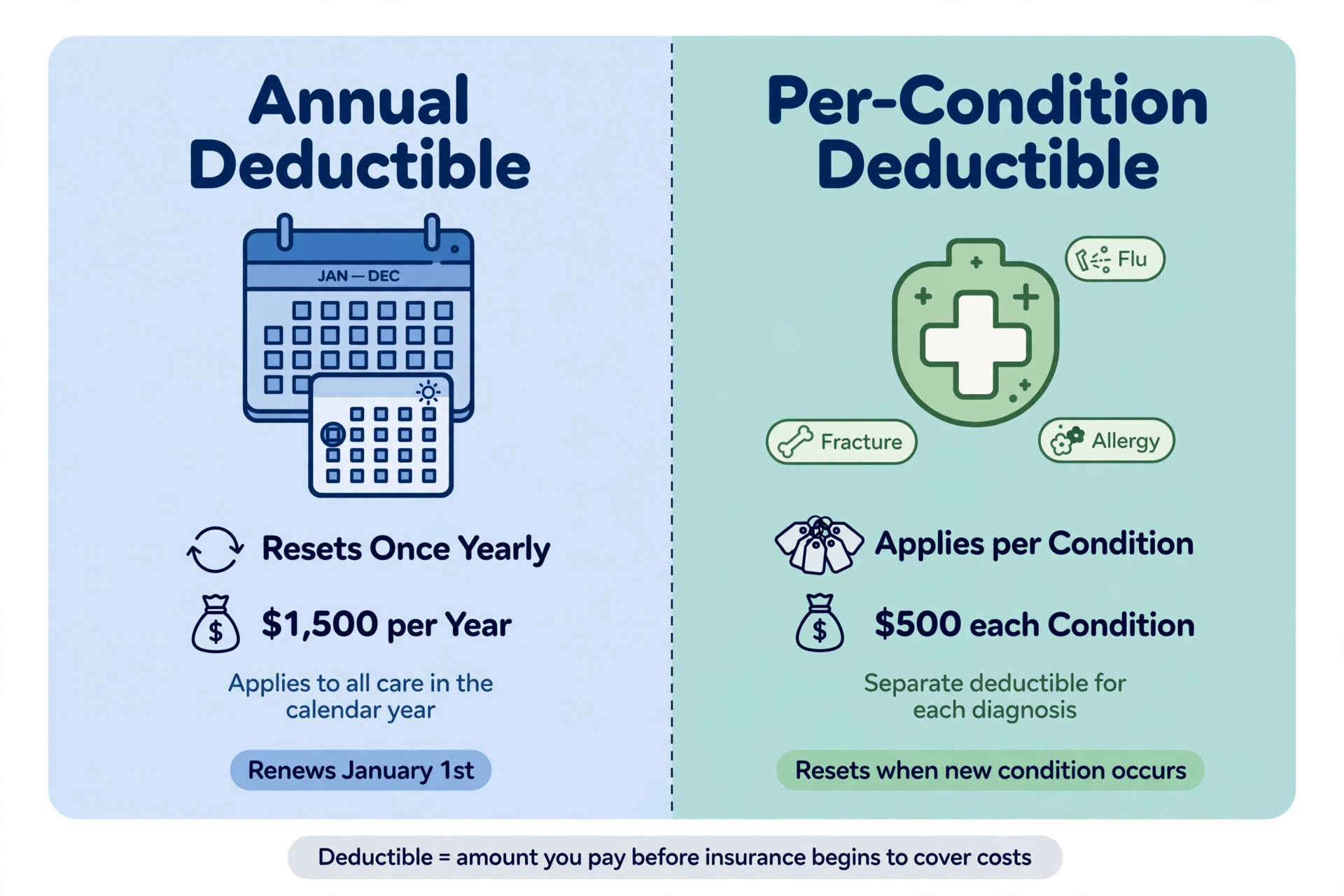
Two structures exist, and they behave very differently. An annual deductible resets once a year — it’s by far the most common type. A per-condition deductible, sometimes called a per incident deductible, applies once per condition for your pet’s whole life and never resets. Annual plans are simpler to follow. Per-condition plans can save real money on a long-term illness that drags across many years.
With an annual deductible, you meet it once per policy year across all conditions combined — say your dog eats something questionable in January and clears the $250 deductible. Every covered bill after that gets reimbursed for the rest of the year, then resets to zero at renewal. Nearly every major US insurer works this way. Money.com’s deductible guide found all but one researched company used annual deductibles.
Trupanion is the lone exception. Its deductible is per-condition and lasts a lifetime: $0–$1,000 in $5 increments, set separately for each condition. Meet it once for, say, hip dysplasia, and you never pay it again for that condition — no annual resets (petinsurancereview.com, 2026 reviews). No other major US provider uses this structure.
Which one wins? It depends on your pet’s health story: a single big accident year favors annual, while a chronic condition favors per-condition. Here’s the multi-year math, kept illustrative:
A dog develops skin allergies needing $1,500 in covered care every year for 4 years, at 80% reimbursement.
Annual $250 deductible: each year you pay $250 + 20% of the remaining $1,250 ($250) = $500/year. Four-year total: $2,000 in out-of-pocket costs.
Per-condition $250 deductible: year one costs the same $500. But the deductible is now met for allergies forever. Years two through four, you pay only 20% of $1,500 ($300/year). Four-year total: $1,400.
The per-condition structure saves $600 over four years on this one chronic condition.
(That’s a simplified comparison to show the mechanics — real plans differ in reimbursement rates and limits. Trupanion’s standard reimbursement, for instance, is 90% with unlimited lifetime payouts.)
Some breeds run up bigger bills than others — and that makes your deductible choice matter more. The French Bulldog is one of the priciest breeds to insure. Our French Bulldog cost guide breaks down why.
What Is a Good Deductible for Pet Insurance?
No single right answer exists. A good deductible is simply one you could pay tomorrow without panicking. Most owners land on $250 or $500. If you have a solid emergency fund, a higher deductible trims your monthly bill. If cash is tight, a lower deductible keeps each vet visit affordable.
The popularity numbers back this up. Spot reports that $250 is the most popular choice among pet parents (Spot, Oct 2026). Wagmo’s CEO has said Wagmo’s most popular deductible is $500 per year (Adopt-a-Pet interview). Insuranceopedia notes that most pet owners pick $250.
Here’s a practical rule of thumb: pick the highest deductible you could pay on a bad day without reaching for a credit card. That’s your sweet spot. A $1,000 deductible saves real money each month — but only if a $1,000 surprise bill wouldn’t wreck your budget. Be honest with yourself here. The “right” deductible fits your actual savings, not the one with the lowest premium.
How Does My Deductible Affect My Premium?
Raise your deductible, and your monthly premium drops. Lower it, and the premium climbs. The gap between a $100 and a $1,000 deductible typically runs $15–$35 a month — $180–$420 a year (Spot). Pick the deductible that fits your budget, not just the cheapest premium.
Insurers price it this way because a higher deductible means fewer payouts for them. You’re carrying more of the risk, so they charge you less. Same logic as car or home insurance.
Now the part most guides skip: the three-way math on the same vet bill. Watch what changes when only the deductible moves. All figures below are illustrative — one $3,000 covered vet bill at 80% reimbursement in 2026:
| $250 deductible | $500 deductible | $1,000 deductible | |
|---|---|---|---|
| Bill | $3,000 | $3,000 | $3,000 |
| Minus deductible | −$250 | −$500 | −$1,000 |
| Insurer pays (80% of rest) | $2,200 | $2,000 | $1,600 |
| You pay (deductible + 20%) | $800 | $1,000 | $1,400 |
Bumping from $250 to $1,000 saves $600 on this one claim. But don’t forget the premium side: that $1,000 deductible might cost $30/month less — $360 a year. In a year with one $3,000 claim, the $250 plan comes out $240 ahead ($600 saved on the claim minus $360 extra premium). In a claim-free year, you paid $360 extra for nothing.
That’s the honest tradeoff. A low deductible is paying for peace of mind. A high deductible is a bet on a healthy year. Neither is wrong — they’re just different bets.
Premiums have been climbing fast — which makes this choice matter more. US pet insurance premiums rose 21.4% in 2024 to over $4.7 billion, covering 6.4 million insured pets (NAPHIA 2024 State of the Industry, via Adopt-a-Pet). Your state, breed, and pet’s age all shift your quotes. Benchmark yours against the national average cost of pet insurance — and since location matters, see what pet insurance costs in Texas for a city-by-city breakdown.
Can You Change Your Pet Insurance Deductible?
Usually yes — but the rules differ by company. Trupanion lets you lower your deductible within 30 days of enrollment and raise it anytime. Pets Best lets you raise it anytime but lower it only at renewal. Most insurers let you change it at renewal (MoneyGeek).
Here’s how the major providers handle it in 2026:
| Provider | Lower your deductible | Raise your deductible | Source |
|---|---|---|---|
| Trupanion | Within 30 days of enrollment | Anytime (monthly price changes) | Trupanion FAQ, Oct 2026 |
| Pets Best | Only at policy renewal | Anytime | Pets Best sample policy |
| Lemonade | Not always allowed | Anytime | Lemonade guide |
| Most other insurers | Usually at renewal | Usually at renewal | MoneyGeek |
Here’s the catch (there’s always one with insurance): if your pet shows signs of a condition before you change your deductible, that condition stays under your old, higher deductible — Trupanion’s FAQ (Oct 2026) states this plainly, so people can’t wait for a diagnosis and then drop their deductible.
So plan ahead: if you think you’ll want a lower deductible someday, day one is the cheapest time to set it. And if money gets tight mid-policy, raising your deductible is the fastest way to cut your monthly bill — most companies allow it immediately.
Is Pet Insurance With No Deductible Worth It?
With a $0 deductible, there’s no out-of-pocket threshold before coverage kicks in — but you still pay your coinsurance share and everything above your annual limit. Worth it if your pet has regular claims. For healthy pets, though, the higher premium often costs more than the deductible would have.
Real $0 options exist in 2026. MetLife offers $0 annual deductibles (alongside options up to $2,500), plus a healthy-pet incentive that drops your deductible $50 for every claim-free year (metlifepetinsurance.com; Pawlicy 2026). Trupanion offers a $0 lifetime per-condition deductible (Pawlicy 2026). Embrace takes a different route: its Healthy Pet Deductible drops $50 each claim-free year and can eventually reach $0, with menu options of $100–$1,000 and 70/80/90% reimbursement (littlefamilyadventure.com, Oct 2026). Lemonade’s 2026 menu runs $100/$250/$500/$750 with 70/80/90% reimbursement (Parade, Oct 2026).
Quick worth-it check, kept illustrative: say a $0 deductible costs $25/month more than a $250 deductible — that’s $300 a year. Your pet has one $800 covered claim that year: the $0 plan pays 80% of $800 ($640), while the $250 plan pays 80% of $550 ($440). You get $200 more back, but you paid $300 extra in premium — net: −$100. The $0 deductible only wins when claims come often enough to beat the premium gap.

Frequently Asked Questions
Is the deductible applied before or after the reimbursement percentage?
Most insurers subtract the deductible first, then apply the reimbursement percentage. On a $1,000 covered bill with a $250 deductible and 80% coverage, the insurer pays 80% of $750 — that’s $600. A few companies apply the percentage first in some cases, which changes the payout. Check your policy’s stated order.
What counts toward my deductible?
Only covered accident and illness expenses count toward your deductible. Routine wellness visits, vaccines, and preventive care usually do not count (NerdWallet, updated Jun 17, 2025). Pre-existing conditions don’t count either. If a bill isn’t eligible for coverage, it can’t help you meet your deductible.
Which deductible is better for a chronic condition?
For a condition needing years of treatment, a per-condition lifetime deductible usually wins — you meet it once and never again for that illness. With an annual deductible, you pay it fresh every year. Run the multi-year math on your pet’s likely treatment costs before you choose.
Can I lower my deductible mid-policy?
Sometimes, but expect limits. Trupanion allows lowering only within 30 days of enrollment. Pets Best allows it only at renewal. And any condition showing signs before the change is handled under your old, higher deductible (Trupanion FAQ, Oct 2026). Insurers set these rules to prevent last-minute gaming.
$250 vs $500 — which should I pick?
Pick $250 if a surprise $500 bill would stress your budget — it’s the most popular choice for a reason (Spot, Oct 2026). Pick $500 if you have savings and want a lower monthly premium. The premium gap between the two is usually modest, so choose based on what you can comfortably pay at the vet.
Does $0 deductible mean I pay nothing at the vet?
No. A $0 deductible removes the threshold, but you still pay your coinsurance share (usually 10–30% of each bill), sometimes called a copay, plus anything above your annual limit. You also still pay the full cost of anything your plan excludes, like pre-existing conditions or routine care.
What is an annual deductible for pet insurance?
It’s the amount you pay toward covered vet bills once per policy year before your insurer starts paying its share. With a $250 annual deductible, you pay the first $250 of covered accident and illness bills that year; after that, your plan pays its percentage (usually 70%, 80%, or 90%) of what remains. It resets to zero at every renewal — and nearly every major US insurer uses this type. Trupanion is the exception, with a per-condition lifetime deductible instead.
Does my deductible reset every year?
An annual deductible resets every policy year — yes. A per-condition lifetime deductible, like Trupanion’s, never resets once met for that condition. Know which type you have before assuming last year’s payments still count toward this year’s claims.
Is pet insurance tax deductible?
Generally no. Pet insurance for a personal pet is treated as a personal expense, not a tax-deductible one. Rules can differ for service animals or animals used in a business, so ask a tax professional about your specific situation rather than guessing.
The bottom line: how do pet insurance deductibles work in practice? It comes down to three choices — the amount, the type (annual vs per-condition), and whether you can change it later. Pick the highest deductible you could pay without stress, match the type to your pet’s health outlook, and re-check the math each renewal. You’ll never overpay for peace of mind.
6 thoughts on “How Do Pet Insurance Deductibles Work? (2026 Explainer)”