
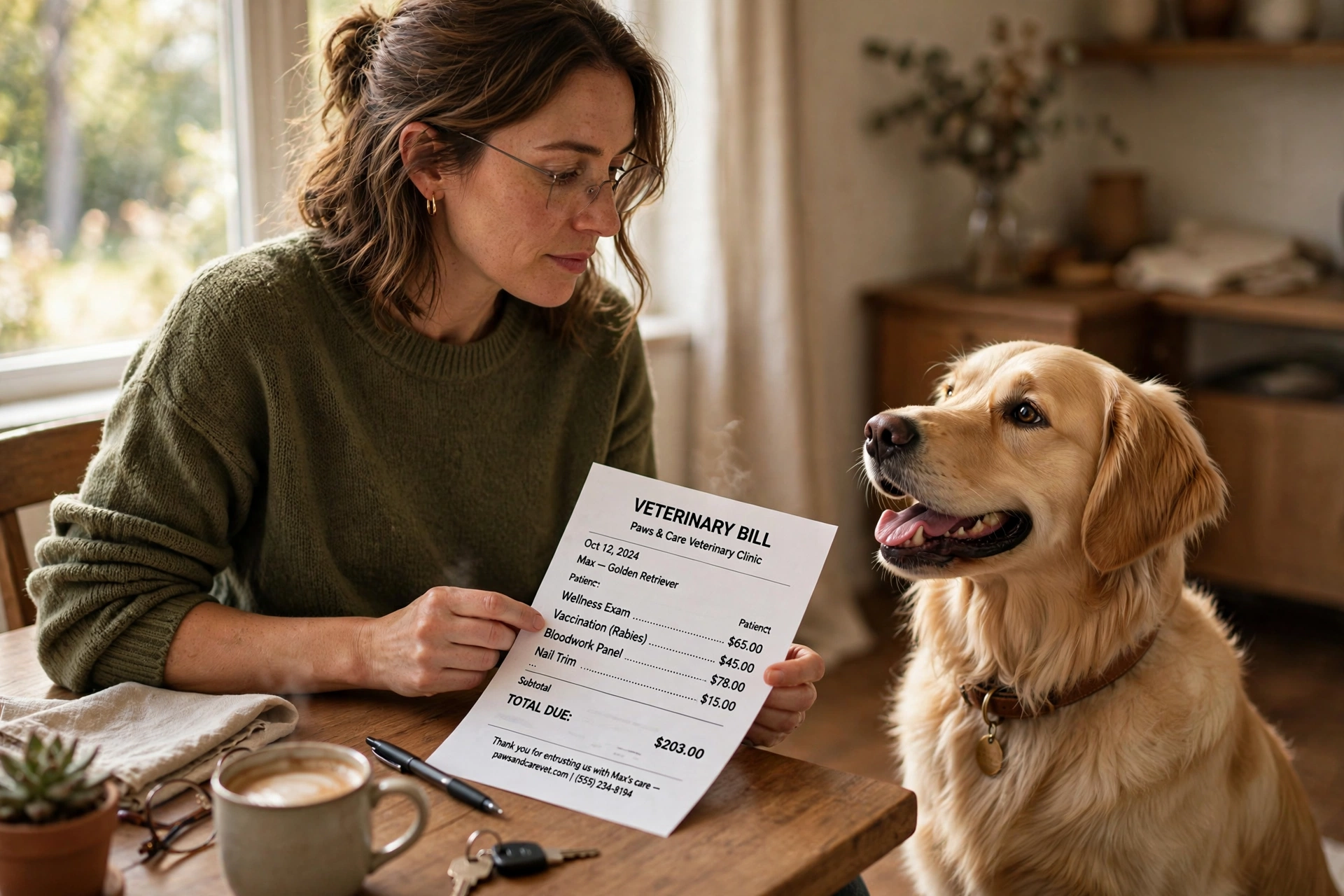
TL;DR: Pet insurance is worth it if a surprise $3,000+ vet bill would hurt your finances. The average dog plan costs about $62/month ($749/year, NAPHIA 2024 data) — one $4,500 emergency surgery roughly pays for four years of premiums. It’s NOT worth it if you keep a real $5,000–$10,000 pet emergency fund you never touch, or if your pet is a senior with pre-existing conditions (premiums run ~3× higher and old problems aren’t covered). The honest answer comes down to one question: could you pay a $5,000 vet bill tomorrow without panic?
Key Takeaways
- The average accident-and-illness plan costs $749/year for dogs ($62/month) and $386/year for cats ($32/month) — NAPHIA’s 2024 US data, published April 2025.
- One $4,500 emergency surgery at 80% reimbursement returns about $3,200 — roughly four years of premiums back in a single claim.
- A healthy pet for 14 years means paying $10,000–$18,000 in premiums for nothing claimed. Insurance companies profit on average — that’s the honest steelman.
- The break-even point is usually one moderate emergency ($3,000–$5,000) in the first half of your pet’s life, or any chronic illness.
- The r/frugal rule: keep a dedicated $3,000 (cat) / $5,000 (dog) emergency nest egg instead — if you can truly leave it untouched.
The Short Answer (30 Seconds)
Ask yourself one question: could you pay a $5,000 vet bill tomorrow without panic?
If the answer is no — or “it would wreck my month” — pet insurance is probably worth it for you. If the answer is a calm yes, because you have a dedicated pet fund sitting in savings, you can likely skip it.
Everything below is the math behind that one question. No hype, no scare tactics — and I’ll show you exactly when insurance is a bad deal, too.
What Pet Insurance Actually Costs in 2026
Let’s start with real numbers, not marketing. The North American Pet Health Insurance Association (NAPHIA) publishes the industry’s official figures every year. Their April 2025 report (2024 US data) says:
Table: Average pet insurance premiums, US 2024 (NAPHIA)
| Plan type | Dogs (per year) | Dogs (per month) | Cats (per year) | Cats (per month) |
|---|---|---|---|---|
| Accident & illness (full coverage) | $749 | $62 | $386 | $32 |
| Accident-only | $193 | $16 | $110 | $9 |
| Wellness-embedded (routine care included) | $1,321 | $110 | — | — |
Two things worth knowing about these numbers:
First, they’re climbing fast. The average dog premium jumped 11% in 2024 alone, from $675 to $749 (NAPHIA). Vet costs are rising even faster — about 51% cumulatively over the last five to six years, according to Bureau of Labor Statistics data cited by Insurify. Insurance prices follow vet prices, always.
Second, age changes everything. A 10-year-old dog costs roughly three times as much to insure as a 1-year-old (Insurify). This matters for the break-even math later — enrolling young isn’t just cheaper this year, it’s cheaper every year after.
For the full premium picture — costs by breed, state, and age — our pet insurance cost guide breaks down 17,000+ quotes.
What Vet Bills Actually Cost
Insurance only makes sense relative to the bills it covers. So what does the vet actually charge?
An emergency exam alone — just walking in the door — runs about $135 for dogs and $143 for cats (CareCredit/Synchrony 2025–2026 data across all 50 states). That’s before any treatment.
A full emergency visit typically lands between $800 and $2,500 for moderate problems, and $3,000 to $8,000+ for major ones like surgery.
Some concrete 2026 figures from our breed research:
- BOAS breathing surgery (French Bulldogs): $3,000–$6,000
- Spine surgery (IVDD): $2,500–$8,000
- Hip dysplasia treatment: $1,500–$6,000
- Cancer treatment: $5,000–$15,000+
One bad day at the emergency vet can cost more than five years of premiums. That’s the entire case for insurance in one sentence.
The Break-Even Math (3 Scenarios)
Here’s what nobody else shows you: three honest scenarios, built on NAPHIA’s real $749/year average for dogs. Same assumptions
throughout: $62/month premium, $500 annual deductible, 80% reimbursement.

Scenario 1: One Emergency in Year 4
Your healthy young dog needs a $4,500 surgery at age 4. Nothing before, nothing after.
- Premiums paid over 4 years: $62 × 48 months = $2,976
- The claim: ($4,500 − $500 deductible) × 80% = $3,200 back
- Your total out-of-pocket: $2,976 + $500 + $800 (your 20%) = $4,276
- Without insurance: $4,500
Result: roughly a wash. One moderate emergency in four years basically pays for itself — you come out a couple hundred ahead, plus you had four years of peace of mind. Honest takeaway: a single claim doesn’t make you rich. It just erases the sting.
Scenario 2: The Lucky Pet (14 Healthy Years)
Your dog lives to 14 and never has a single covered claim. Lucky you — and unlucky for your wallet:
- Lifetime premiums: roughly $10,000–$18,000 (premiums rise with age, so the later years cost far more than $62/month)
- Claims paid: $0
Result: insurance “loses” by five figures. This is the steelman of the anti-insurance case, and it’s real: insurance companies make money because the average owner pays in more than they get back. That’s how insurance works — the lucky many fund the unlucky few. If your pet is the lucky one, you paid for peace of mind you never cashed in.
Scenario 3: Chronic Illness at Age 6
Your dog is diagnosed with diabetes at 6 — manageable, but it needs ~$2,000/year in treatment for the rest of her life (say 6 more years = $12,000 total).
- Each year: ($2,000 − $500 deductible) × 80% = $1,200 back per year
- Over 6 years: $7,200 reimbursed
- Premiums over those 6 years (ages 6–12, when prices are higher): roughly $6,000–$8,000
Result: insurance wins clearly — and that’s before counting any other illness in those years. Chronic conditions are where insurance earns its keep, because the payouts stack year after year while a savings account drains once.
Do the Math Yourself (4 Steps)
Copy this with your own numbers:
1. Your lifetime premium estimate: your quoted monthly premium × 12 × your pet’s expected remaining years. (Use a higher number for later years — remember the 3× age curve.)
2. Subtract the deductible drag: $500 × the number of years you expect to claim. (You pay the deductible fresh every year.)
3. Compare against your real emergency fund: not the fund you plan to build — the one sitting in your account right now.
4. Apply the timing trap: an emergency in year 1 crushes a savings plan (you haven’t saved enough yet) but barely dents insurance math. An emergency in year 12 flips it — you’ve paid a decade of premiums.
If step 3’s number is under $3,000 and your pet is young, insurance usually wins. If it’s over $10,000 and you genuinely won’t touch it, self-insuring usually wins.
Pet Insurance vs. Savings Account — Side by Side
Table: Insurance vs. saving $62/month yourself
| Pet insurance ($62/mo) | Dedicated savings ($62/mo) | |
|---|---|---|
| Year-1 emergency ($5,000 bill) | Covered — you pay ~$1,400 | Disaster — you’ve only saved $744 |
| 14 healthy years | $10k–$18k spent, $0 back | $10k–$18k still yours |
| Chronic illness | Pays year after year | Drains fast, then it’s gone |
| Pre-existing conditions | Not covered (enroll early!) | Doesn’t matter — it’s your money |
| Discipline required | None — auto-billed | Extreme — most people raid the fund |
| Premium increases | Yes, with age and inflation | N/A |
The savings column looks better on paper. In real life, the “discipline required” row is where savings plans go to die — the fund becomes a vacation, a car repair, a holiday. Be honest with yourself about which row describes you.
When Pet Insurance IS Worth It
1. You have a young, healthy pet. Premiums are at their lifetime lowest, nothing is pre-existing yet, and you lock in the cheap years. A 1-year-old costs a third of a 10-year-old to insure.
2. You own a high-risk breed. French Bulldogs, German Shepherds, Great Danes — breeds with expensive known problems. When a single BOAS surgery costs $3,000–$6,000, the math tilts hard toward coverage. (See our French Bulldog cost guide for the breed-level numbers.)
3. Your emergency fund is thin. If a $3,000 bill means credit-card debt, insurance is buying you out of a debt spiral. This is its highest-value use.
4. You’re a peace-of-mind buyer. Some people sleep better knowing the decision at the emergency vet will be about medicine, not money. That’s a legitimate purchase — just know you’re buying certainty, not profit.
5. You have multiple pets. Multi-pet discounts (usually 5–10%) stack the math in your favor, and the odds of at least one emergency across several animals are much higher than for one.
Not sure which plan type fits? Our plan types guide compares accident-only vs. accident-and-illness vs. wellness add-ons with real prices.
When It’s NOT Worth It (Honest)
1. You hold a real emergency fund. $5,000–$10,000 in a separate account that you never touch for anything else. Not “I’ll build one.” One that exists today. If that’s you, congratulations — you’re the insurance company now, and you keep the profits.
2. Your pet is a senior with diagnosed conditions. Here’s the trap: premiums at age 10+ run ~3× puppy prices, and every condition already on the vet record is excluded as pre-existing. You’d pay the highest prices for the thinnest coverage. (Our senior dog insurance guide shows the age curve — run the numbers before enrolling an older dog.)
3. You only want routine care covered. Wellness add-ons ($10–$60/month extra) basically pre-pay for vaccines and checkups — plus the insurer’s overhead. For routine care alone, paying the vet directly is usually cheaper.
4. The plan math is bad. $100/month for a $5,000 annual cap is a poor deal — one moderate emergency exhausts the cap and you’ve still paid $1,200/year for the privilege. Always compare the annual limit against realistic worst-case bills.
5. You’d buy it and never claim. Sounds obvious, but some owners buy a plan, then avoid the vet because of the deductible “hassle.” An unused plan is just a donation to the insurer.
The $3,000 / $5,000 Rule
On r/frugal, a veterinarian laid down a rule that gets quoted constantly: keep a dedicated $3,000 emergency nest egg for a cat, $5,000 for a dog — and skip insurance if you can fund it.
It’s good advice, with three holes worth knowing:
1. The year-1 hole. The rule assumes the fund exists before the emergency. A $4,500 surgery in month 3 of pet ownership beats a fund you’re still building.
2. The chronic-illness hole. $5,000 covers one emergency. It doesn’t cover six years of diabetes at $2,000/year.
3. The human hole. Most people don’t keep a dedicated fund dedicated. The money migrates.
Steelman complete: if you can genuinely hold the fund untouched from day one, the rule works. Most of us can’t — and that’s exactly who insurance is for.
Your deductible choice moves all of this math. A higher deductible lowers the monthly price but raises what you pay per claim — our deductibles explainer walks through the $250 vs. $500 vs. $1,000 trade-off with real claim examples.
Comparing two specific brands instead? Our Spot vs Trupanion comparison runs the same $5,000 vet bill through both plans, step by step.
Frequently Asked Questions
Is pet insurance worth it for an indoor cat?
Often less so than for dogs — cats average $32/month to insure and tend to have fewer expensive emergencies, especially indoors. But one urinary blockage ($1,500–$3,000) or swallowed-string surgery can still dwarf years of premiums. If your cat is young and your fund is thin, it’s still reasonable.
Is pet insurance worth it for a healthy young dog?
This is actually the best time to buy: premiums are at their lifetime lowest and nothing is pre-existing yet. You’re not buying it because your puppy is sick — you’re buying cheap access to coverage for the decade ahead, when the expensive stuff happens.
At what age does pet insurance stop being worth it?
There’s no cutoff, but the math sours with age: premiums at 10+ run roughly 3× puppy prices, and pre-existing conditions pile up. For a healthy senior with no diagnosed issues, it can still make sense. For a senior with a thick vet file, usually not.
Is it better to save money or get pet insurance?
Saving wins if you actually save — a dedicated, untouched $5,000–$10,000 fund beats insurance mathematically. Insurance wins for everyone else, because it covers the year-1 emergency you’d never have saved for in time, and it can’t be raided for a vacation.
How much should I save for vet bills instead of buying insurance?
The r/frugal rule of thumb: $3,000 for a cat, $5,000 for a dog, in a dedicated account. For a high-risk breed or a senior, double it — one surgery can clear $5,000 in a day.
Does pet insurance ever pay for itself?
Yes — typically on the first moderate emergency. A $4,500 surgery at 80% reimbursement returns ~$3,200, roughly four years of average premiums. Chronic illnesses pay back even more over time. What doesn’t pay for itself is 14 claim-free years — that’s the trade you accept.
Is pet insurance worth it if my pet has pre-existing conditions?
Usually not — pre-existing conditions are excluded by nearly every plan, so you’d pay full price for partial coverage. The exception: a young pet with one minor resolved issue (say, a single ear infection) can still be worth covering for everything else.
What is the break-even point for pet insurance?
Roughly one $3,000–$5,000 emergency in the first half of your pet’s life, or any chronic condition needing $1,500+/year in ongoing care. Below that, the insurer profits off you. Above it, you profit off the insurer.
The bottom line: pet insurance is worth it when a surprise vet bill would hurt — which, for most owners, is most of the time. At ~$62/month, one moderate emergency in the first few years pays for the whole experiment, and a chronic illness pays for it many times over. It’s not worth it if you’re sitting on an untouched $10,000 pet fund or insuring a senior with a full medical file. Run your own four-step math above, be honest about the fund you’d actually keep, and decide like someone spending their own money — because you are.
Disclosure: Figures in this article come from published sources dated 2025–2026, noted where they appear. Premiums vary by breed, age, location, and plan details — get your own quotes before deciding. This article covers the money side of pet insurance only; for health questions, confirm with your veterinarian.