

Short answer: does pet insurance go up after a claim? At most big US insurers, no. Ten of the fourteen major insurers say in writing that your premium will not rise because you filed a claim, and that count includes Embrace, whose policy paper says no but whose position is contested. But three warnings sit under that answer. Fetch says yes, openly, on its own claims page. Pumpkin and Figo say no in their marketing, but their own state papers say premiums may move with claims history. And your premium will still rise at renewal even if you never claim, because your pet ages and vet costs rise. The table below gives you the answer for your insurer, by name.
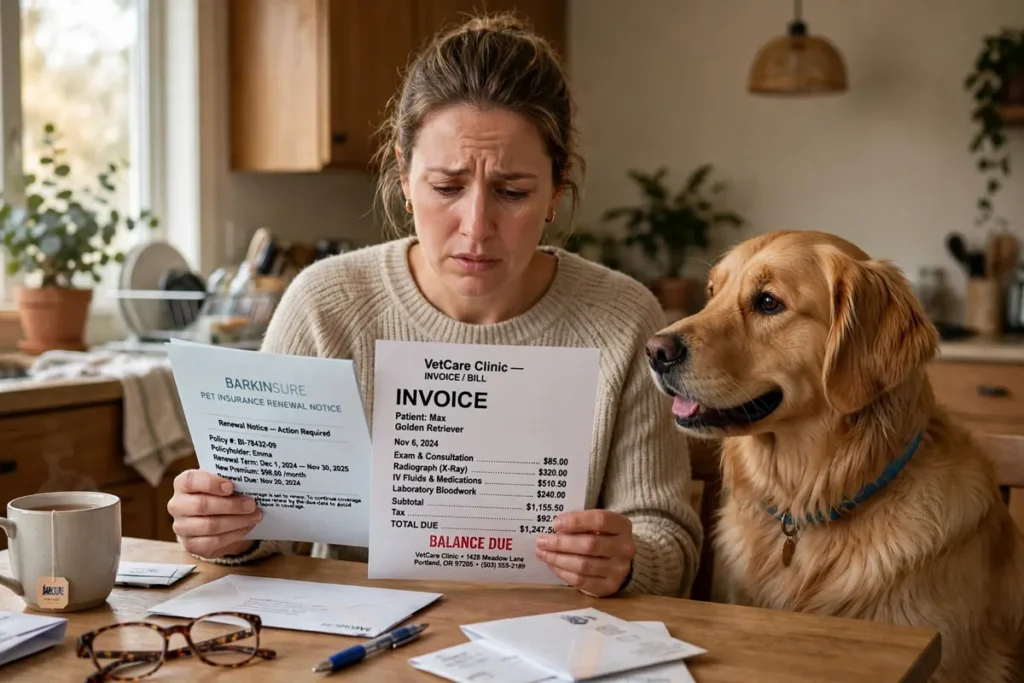
One pet owner learned this the hard way. He had an ASPCA policy and paid $776 a year. Then his dog needed a major claim, the first big one he ever filed. The day after the claim, his renewal price came in at $1,156 a year. That is a 49 percent rise, overnight, right after the first claim.
He posted the story on PetInsuranceReview, and ASPCA replied. The company said the rise came from overall spending, not from his claim. ASPCA’s own policy paper promises that it will not raise your premium because of your claims history. So who is right? The owner saw a price jump the day after a claim. The insurer said the claim had nothing to do with it.
This article cannot settle that one case. What it can do is show you what each insurer actually promises, in writing, and where the fine print says something different. Because the real question is not whether one owner got unlucky. It is whether your insurer can raise your price after you claim, and whether you would even know. Keep reading. The answer is mostly good news, with three traps you need to see before your next renewal.
The Promise Every Insurer Makes
Open any big insurer’s site and you will find the same promise, in different words. Your premium does not go up because you filed a claim. Your claims history does not move your price. The promise is so common that most owners never question it.
Here is what it actually covers. A pet insurance policy runs for one year at a time. During that year, your rate is locked. Filing a claim in March cannot raise the price you pay in April, because the insurer set the rate when the policy started. The promise is about claims, not about everything else. Your premium can still rise at renewal for other reasons, and the next sections show you which ones.
The promise also has a limit most owners miss. It covers your own claims, not the claims of everyone else. Healthy Paws says it plainly: your premium does not rise from your own claim submissions, but it can rise because of all the claims from customers in your region. You can do everything right, file nothing, and still pay more because the pool you sit in got more expensive. Our guide to how pet insurance works explains how the pool and the pricing fit together, and our guide to the types of pet insurance plans shows which plan shapes leave you most exposed to a renewal rise.
So the promise is real, and it is also narrow. It says: your claim, on its own, does not raise your price. It does not say: your price will never rise. That gap is where the rest of this article lives.
The Fine Print That Breaks the Promise
Now the part no insurer puts on its homepage. In some states, the same insurers that promise “no rise from claims” have filed papers that say the opposite.
Pumpkin. Pumpkin’s FAQ says your premium will not rise based on the size or amount of the claims you file, approved or denied. That sounds like a promise. But Pumpkin’s own state notices for Louisiana, Rhode Island, Maine, Maryland, Delaware, Pennsylvania, Hawaii, Montana, Mississippi and Nebraska say premiums “may increase or decrease due to claims history”. The Florida notice says the opposite: it will not rise from claims history. So a Pumpkin owner in Florida has a written promise, and a Pumpkin owner in Pennsylvania has a written warning, from the same company.
Figo. Figo’s marketing and most reviews say Figo will not raise your rates for claims. But Figo’s own Florida disclosure, filed with the state, says “Premiums may increase or decrease due to claim history.” The marketing says no. The paper the state holds says may. If you live in Florida, the paper is the one that counts.
Embrace. Embrace is the contested one. Its California disclosure says “Premiums do not increase due to claim history.” But the Wall Street Journal’s Buy Side review of Embrace says rates could increase at renewal based on claims you have made. One owner review site lists Embrace’s position as “not clear”. Both sides are on the record, and they disagree. If you have Embrace, the only safe move is to ask the company in writing, before you buy or before you renew, whether your claims history can move your premium. Our MetLife vs Embrace guide goes into the Embrace pricing details.
Why does this happen? Because insurers file different papers in different states, and the marketing page is written for the whole country. The state paper is written for your state, and it is the paper that governs your policy. Before you buy, read the disclosure for your state. It is usually a PDF linked from the insurer’s legal page, and it takes two minutes to check.
The Full Table: 14 Insurers, One Answer Each
Here is the answer to “does pet insurance go up after a claim” for every major insurer, checked against each company’s own site, policy paper or FAQ on 13 November 2026. Ten say no in writing, and that count includes Embrace, whose paper says no but whose position is contested. Fetch says yes. Pumpkin and Figo split by state. Nationwide lists claim history as a renewal factor.
| Insurer | Does a claim raise your premium? | What the source actually says |
|---|---|---|
| Trupanion | No | “Your premium does not go up because you filed a claim or your pet needs care.” Own site. Premium may move with vet costs, and not more than once in any 12 months. |
| Lemonade | No | “Your premiums won’t increase at renewal just because you have a claim.” Own policy disclosure. Also: “Premiums will not be affected due to claims history.” |
| Spot | No | “Your premium will not increase due to filing a claim.” Own site FAQ. |
| Healthy Paws | No for your own claims | “Premiums do not increase from individual claim submissions.” But your premium may rise based on all claims from customers in your region. |
| Embrace | Conflict | Own California disclosure: “Premiums do not increase due to claim history.” Wall Street Journal Buy Side review: rates could increase at renewal based on claims made. Ask in writing before you buy. |
| Pets Best | No | “We do not reduce coverage or increase premiums based on the policyholder’s claim history.” Own policy form IAIC-PB10001-ILL. Blog FAQ: “your premium isn’t increased because you submit a claim.” |
| ASPCA | No, in writing | “We will not reduce coverage or increase premium due to claims history.” Own California policy notice. One owner reported a 49 percent rise after his first big claim; ASPCA said it was overall spending, not the claim. |
| MetLife | No | “The Policy does not reduce coverage or increase premiums based on the Pet Parent’s claim history.” Own disclosure PDFs for California, Ohio, Rhode Island, New Hampshire, Hawaii, Maryland, Montana and Washington. Note: the sample policy says claim history may affect your deductible and policy limit, not your premium. |
| Pumpkin | Split by state | Own FAQ says your premium will not rise based on the size or amount of claims you file. But state notices for Louisiana, Rhode Island, Maine, Maryland, Delaware, Pennsylvania, Hawaii, Montana, Mississippi and Nebraska say premiums “may increase or decrease due to claims history”. The Florida notice says it will not. |
| Figo | Split | Reviews and the Wall Street Journal say Figo will not raise rates for claims. But Figo’s own IAIC Florida disclosure says “Premiums may increase or decrease due to claim history.” |
| Fetch | Yes | “The short answer is yes, filing claims can cause your pet insurance premium to increase when your policy renews.” Own claims page. It will not cancel policies based on claims history. |
| Nationwide | Claims history is a listed renewal factor | Own benefit booklet: “Premiums may increase at renewal based on various factors like a pet’s age, size, location, or claim history.” No blanket no-increase promise found. |
| Odie | No | “Your premium will NOT change based on your Pet’s individual claims experience.” Own sample policy, underwritten by Trisura. |
| AKC | No | “AKC Pet Insurance will not increase any policyholder’s rates based on the number of claims filed or the amount of reimbursement provided.” Own FAQ. California disclosure says the same. |
Two things to notice in the table. First, the insurers that say no say it in their own documents, not in ads. You can check each one yourself from the sources at the end of this article. Second, the three problem rows are not small print in a blog. They are the insurers’ own state filings, and they are the reason you should read your own policy paper, not just the homepage.
Fetch, the Honest Outlier
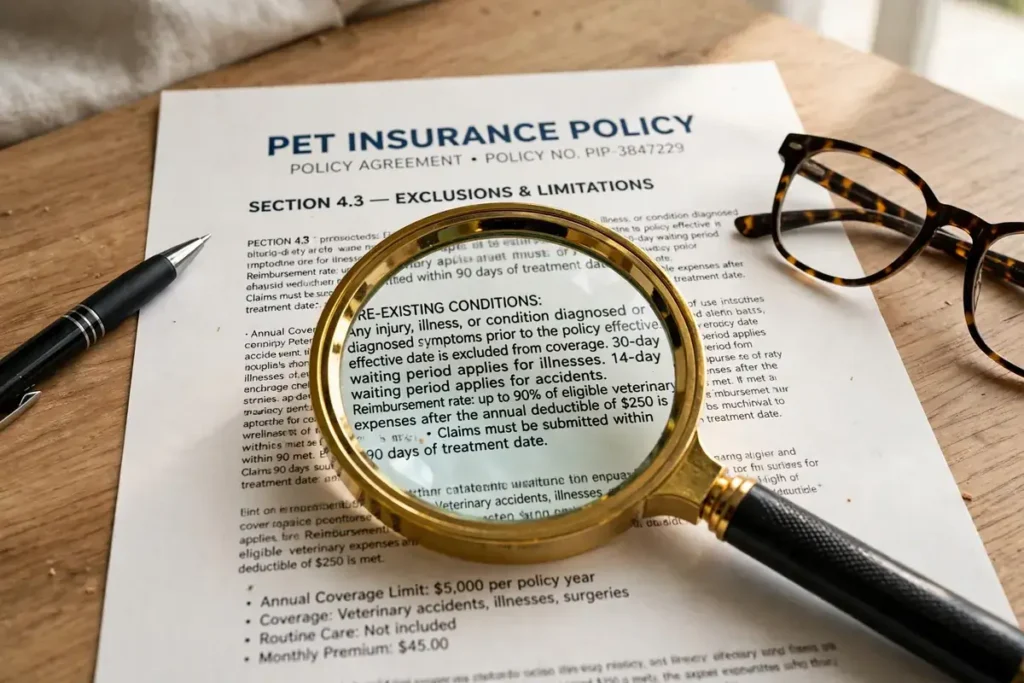
Fetch is the only big insurer that says yes, out loud, on its own site. On its claims page, Fetch answers the question directly: “The short answer is yes, filing claims can cause your pet insurance premium to increase when your policy renews. Most insurance providers adjust rates based on your pet’s age, regional veterinary costs and your overall claims history.” That is the exact wording from Fetch’s own claims page, checked again on 13 November 2026.
Fetch also says what it will not do. It will not cancel your policy based on claims history. And it will work with you on the price: if you want a lower premium, it can lower your maximum annual payout, your deductible or your reimbursement rate. Claims are usually processed in less than 10 days, and you must file within 90 days of the vet visit.
Is Fetch’s honesty a reason to avoid it? Not on its own. Fetch pays back up to 90 percent of covered vet bills, and it has paid back more than $500 million in claims since 2021. The honest answer is worth something: with Fetch you know the rule before you claim, and you can plan around it. With the split insurers, you only find out at renewal. If you already have Fetch, our Fetch vs Lemonade guide compares it with the cheapest big rival, and it shows where Fetch costs more.
Why Your Price Rises Anyway
Even if your insurer never punishes a claim, your premium will still rise at renewal. Three reasons drive it, and none of them is your fault.
Your pet gets older. Age is the biggest single driver of price. An older pet costs more to insure because older pets need more vet care. WhichPetPlan’s review notes that Healthy Paws premiums climb steeply after around age eight. Every insurer prices by age, and the rise gets steeper as the pet gets older.
Vet care gets more expensive. The cost of vet treatment rises every year, for every pet, in every state. The industry numbers show it: the average dog premium was $836 a year in 2025, up 11.5 percent on the year before, and the average cat premium was $435 a year, up 12.6 percent, according to NAPHIA 2026 data. Accident-only cover for dogs averaged $190 a year. Those rises hit you whether you claimed or not.
The pool pays for everyone. Pet insurance works by pooling risk. Your premium reflects the claims of all the pets in your region and age group, not just yours. Healthy Paws says this openly: your premium can rise because of all the claims from customers in your region. The market is growing fast, with 7.6 million pets insured in 2025, up 8.5 percent from 7.03 million, and $6.2 billion in premiums written, up 19.4 percent. More pets, more claims, higher costs for everyone in the pool.
Put together, that is why a renewal letter can show a higher price even when you never filed a claim. It is not a punishment. It is age, vet inflation and the pool, and it is the same at almost every insurer. The question is not whether your price will rise. It is how much, and what you can do about it.
File It or Pay It: The Small Claim Math
Here is the question that follows from everything above. You have a $300 vet bill. Do you file the claim, or pay it yourself?
Do the math first. The insurer subtracts your deductible, then pays a percentage of what is left. With a $250 deductible and 80 percent cover, a $300 bill pays you $40. That is $300 minus $250, which is $50, and 80 percent of $50 is $40. You get $40 back, and you now have a claim on your record. At Fetch, that claim can count at renewal. At most other insurers it cannot raise your price, but it is still on your record, and it can matter if you switch insurers later, because a new insurer will ask about your claims history.
Now try a bigger bill. A $1,200 emergency bill with a $500 deductible and 80 percent cover pays you $560. That is $1,200 minus $500, which is $700, and 80 percent of $700 is $560. That is worth filing. The claim is the reason you bought the cover.
The rule is simple. If the bill is close to your deductible, filing pays you little or nothing, so paying it yourself is usually the better move. If the bill is far above your deductible, file it. That is what the cover is for. Our guide to pet insurance deductibles explains how the deductible works in detail, and our guide to pet dental insurance shows the same math for dental claims, which are often small and close to the deductible.
One more thing to check before you file: your waiting periods. If the condition started during a waiting period, the claim will be denied and you will still have a claim on your record. Our waiting periods guide lists every insurer’s waits.
Your Renewal Playbook
When the renewal letter lands with a higher price, you have three levers, and one trap.
Lever one: raise the deductible. A higher deductible cuts the monthly price, because you agree to pay more of each claim yourself. It is the most predictable lever: you know exactly what it costs you, once a year, if you claim.
Lever two: lower the reimbursement rate. Dropping from 90 percent to 80 percent, or from 80 to 70, cuts the premium, but the insurer pays a smaller share of every bill after the deductible. Use this lever after the deductible, not before it, because a lower reimbursement rate costs you on every claim, while a higher deductible costs you once a year.
Lever three: drop the add-ons. Wellness add-ons, exam fee cover and extra riders add to the monthly price. If money is tight, drop them before you touch the core cover. The core accident-and-illness plan is the part that protects you from the big bill.
The trap: switching. A cheaper quote from a new insurer looks like a fix, and sometimes it is. But switching has a cost that the quote does not show. A new policy means new waiting periods, usually 14 days for illness and up to 6 months for cruciate ligament problems. Any condition your pet already has becomes a pre-existing condition at the new insurer, and pre-existing conditions are excluded. So a pet that claimed for a skin allergy last year may find that allergy excluded at the new insurer, even though the old one covered it.
Before you switch, ask the new insurer in writing what is excluded, and compare the real cover, not just the monthly price. Our guide to whether pet insurance is worth it helps you weigh the monthly cost against the risk the cover actually removes, and our MetLife vs Nationwide guide shows how two big insurers compare on price and cover.
Two rewards are worth knowing about. Embrace drops your deductible by $50 for every year you do not claim, and Figo’s diminishing deductible drops $50 per claim-free year until it reaches zero. If you go claim-free for a few years, those rewards cut the cost of the next claim. Ask your insurer about the claim-free rewards before you renew, and get the answer in writing.
When the renewal letter arrives, check the notice period. Pets Best sends its renewal notice 35 to 80 days before renewal, depending on the state. Trupanion will not adjust your premium more than once in any 12-month period, and it gives at least 30 days notice. Use that window to get fresh quotes from at least three insurers, and to ask your current insurer to match the best one.
What the Law Forces Insurers To Tell You
There is a law that helps you, and most owners have never heard of it. The NAIC Pet Insurance Model Act, adopted in August 2022, says insurers must tell you in writing, before you buy, whether your premium can rise based on claims history, your pet’s age, or a move. It also says a condition covered under your policy cannot be reclassified as pre-existing when the same insurer renews it.
As of Summer 2026, 17 states have adopted the act: California, Delaware, Florida, Hawaii, Louisiana, Maine, Maryland, Mississippi, Montana, Nebraska, New Hampshire, New Jersey (the law takes effect on 1 January 2027), Ohio, Pennsylvania, Rhode Island, Vermont and Washington.
If you live in one of those states, your insurer has to put the answer in your policy papers before you pay. Read the disclosure for your state, not the marketing page. It will say, in plain words, whether claims history can move your premium. If you live in another state, the insurer does not have to tell you, so ask in writing and keep the reply. A written answer before you buy is worth more than a promise on a homepage after a claim.
One more protection from the same law: if your insurer covers a condition this year, it cannot call that condition pre-existing next year just because you claimed for it. That protection only holds with the same insurer. If you switch, the new insurer can treat it as pre-existing. That is another reason to think twice before switching for a cheaper quote.
Frequently Asked Questions
Does pet insurance go up after a claim?
Mostly no. At most big US insurers your premium will not rise because you filed a claim. Fetch is the exception: it says so itself on its claims page. Pumpkin and Figo say no in their marketing, but their own state policy papers say premiums may move with claims history in most states.
Will my premium go up if I never file a claim?
Yes, usually. Your pet gets older every year, and vet costs rise for everyone. The average dog premium rose 11.5 percent in 2025 to $836 a year, according to NAPHIA 2026 data. That rise hits you whether you claimed or not.
Which pet insurance companies do not raise premiums after a claim?
Trupanion, Lemonade, Spot, Healthy Paws, Pets Best, ASPCA, MetLife, Odie and AKC all say so in writing, in their policy papers or on their own sites. Embrace says so in its policy papers too, but one major review says its rates could rise at renewal based on claims. Fetch is the only big insurer that says yes, claims can raise your premium.
Does Fetch raise your premium after a claim?
Yes. Fetch says so on its own claims page: filing claims can cause your premium to increase when your policy renews, because it looks at your age, your area’s vet costs and your overall claims history. It also says it will not cancel your policy for claims history.
Can pet insurance cancel my policy if I file too many claims?
Fetch says it will not cancel a policy based on claims history. Trupanion says it will not cancel coverage after a set number of claims. Most other big insurers make no promise either way in public, so check your own policy paper before you assume anything. One review site says a few carriers can refuse to renew high-claims policies, but it names no carrier, so treat that as unverified.
Should I file a small claim or pay the vet bill myself?
Do the math first. If the bill is close to your deductible, filing pays you little or nothing, because the insurer subtracts the deductible first. Example: a $300 bill with a $250 deductible and 80 percent cover pays you $40. You still have a claim on your record, and at Fetch that claim can count at renewal. If the bill is far above your deductible, file it, that is what the cover is for.
How much will my pet insurance go up at renewal?
No cap is named in the sources we checked. Rate filings go to state regulators, and your insurer must tell you the new price before renewal. The industry average dog premium was $836 a year in 2025, up 11.5 percent on the year before, and the average cat premium was $435 a year, up 12.6 percent. Your own rise depends on your pet’s age, your area and your insurer, and it can be far above the average for older pets.
What does the law say about premium increases after claims?
The NAIC Pet Insurance Model Act says insurers must tell you in writing, before you buy, whether your premium can rise based on claims history, your pet’s age, or a move. 17 states adopted the act as of Summer 2026. In those states you can read the answer in your own policy papers before you pay.
Sources
- Fetch Pet Insurance: claims page (the exact “yes” quote, claims processed in less than 10 days, file within 90 days)
- NAPHIA 2026 State of the Industry Report, via RatesChaser (average dog and cat premiums)
- NAPHIA 2026 data, via PawPrimer (market size, insured pets)
- NAIC Pet Insurance Model Act, Summer 2026 tracker, via Compare Pet Coverage (the 17-state list)
- LegalClarity: Does Pet Insurance Go Up If You Claim? (direct-answer competitor, NAIC list outdated at 16 states)
- WhichPetPlan: Why Did My Pet Insurance Premium Go Up? (why premiums rise, Healthy Paws age note)
- Trupanion: premium promise and once-per-12-months rule
- Lemonade: policy disclosure (premiums not affected by claims history)
- Spot: FAQ (premium will not increase from filing a claim)
- Pets Best: blog FAQ and renewal notice (35 to 80 days before renewal)
- ASPCA: California policy notice (no rise from claims history)
- MetLife: disclosure (no rise from claims history)
- Pumpkin: FAQ (no rise from individual claims) and state notices (split by state)
- Figo: IAIC Florida disclosure (premiums may move with claim history)
- Nationwide: benefit booklet (claim history as a renewal factor)
- Odie: sample policy (premium will not change from individual claims)
- AKC: FAQ (no rise from number of claims)
- Wall Street Journal Buy Side: Embrace pet insurance review (rates could rise at renewal based on claim history)