

How much does pet insurance cost for a Labrador Retriever? About $56 per month for a typical 3-year-old, according to Forbes Advisor’s 2026 analysis of accident-and-illness plans ($5,000 annual limit, $250 deductible, 80% reimbursement). Choose unlimited coverage instead and the same dog averages about $76 per month. Puppies cost less, seniors cost a lot more, and the spread between companies is wide — MoneyGeek’s quote data for Labs runs from $33 to $129 a month for the same breed.
Labs sit in the middle of the pack on price, and this guide shows exactly why. You will see the real cost at every age, the vet bills that drive the price (knees and hips, mostly), and one piece of fine print that matters more for this breed than any other: the waiting period for cruciate ligament injuries, which runs from 14 days to a full 6 months depending on the company you pick. If you are new to how these plans pay out, our guide to how pet insurance works covers the basics first.
The short answer: Labrador Retriever insurance costs about $56/month for a young adult dog (Forbes Advisor, 2026), around $48/month for a puppy (Insurify), and roughly $138/month for a senior (Insurify). Labs are mid-priced because their risks are real but predictable: joint problems, knee ligament tears, ear infections, and weight gain. The plan matters less than the fine print — cruciate ligament cover starts after 14 days at some brands and after 6 months at others. Enroll as a puppy, pick a plan with a short (or waivable) knee waiting period, and the breed’s most common five-figure bills are covered.
Key Takeaways
- A Labrador costs about $56/month to insure at age 3 (Forbes Advisor); puppies ~$48, seniors ~$138 (Insurify). Age moves the price more than anything else.
- Labs are a mid-pack breed: far cheaper than a French Bulldog (~$90/month), close to a Golden Retriever (~$61/month) — because their health risks are common but rarely extreme.
- The breed’s signature bills are knees and hips: TPLO knee surgery averages $3,525 (CareCredit), and hip replacement runs $3,500–$7,000+ per hip (MetLife).
- Cruciate waiting periods are the trap. Pumpkin covers knee injuries after 14 days; Embrace, Fetch, and Lemonade make you wait 6 months. A tear during the wait becomes a pre-existing condition.
- About 1 in 4 Labs carries a gene (a POMC variant, University of Cambridge research) that makes them hungrier and heavier — and extra weight is rocket fuel for joint claims.

How much does Labrador Retriever pet insurance cost?
Start with the honest headline: there is no single price, but the measured averages cluster tightly. Forbes Advisor’s 2026 analysis puts a 3-year-old Lab at about $56/month with a $5,000 annual limit, or $76/month with unlimited coverage (both at a $250 deductible and 80% reimbursement). ValuePenguin’s cross-company average for the breed is lower — $41.05/month — because it averages cheaper plan setups. And MoneyGeek’s data holds a fun fact: when you read that “the average dog costs $61/month to insure,” that average dog is a Labrador. MoneyGeek builds its national benchmark on a 6-year-old Lab ($5,000 limit, $500 deductible, 80%), and quotes for that profile ranged from $33 to $129 a month across insurers.
Three settings shape every quote you will get. The deductible is what you pay each year before the plan pays anything. The reimbursement rate is the share of each covered bill the plan pays back (70%, 80%, or 90% are typical). The annual limit is the most the plan pays in a year — and for a breed whose knee surgery alone can run past $6,000 with rehab, that limit deserves more respect than the monthly price. Our pet insurance cost guide breaks down U.S. averages across all breeds and plan types.
Why the wide spread between companies? Insurers price the same Lab very differently — MoneyGeek measured Fetch at $70/month on its benchmark Lab profile, about 13% above the all-company average, while budget brands quote the same dog in the $30s. Same dog, same coverage settings, wildly different prices. That is why the single best money move in this guide is boring: get at least three quotes with your own ZIP code before you buy.
What does it cost at every age?
Age is the biggest lever on a Lab’s premium. Here is the age curve, with every row labelled by its source — brands and analysts measure differently, and we would rather show you the seams than fake a single perfect table.
Table: Labrador Retriever insurance cost by age (2026)
| Age | Typical monthly premium | Source |
|---|---|---|
| Puppy (under 1 year) | ~$48 | Insurify quote data |
| 1 year | $45–$50 | Lemonade (official breed page) |
| 3 years | ~$56 | Forbes Advisor analysis ($5,000 limit) |
| 5 years | $60–$65 | Lemonade (official breed page) |
| 7 years | $85–$90 | Lemonade (official breed page) |
| Senior (10+ years) | ~$138 | Insurify quote data |
| First enrolling at age 10 | ~$160 | PetMD (multi-company quotes) |
Two patterns matter. First, premiums roughly triple between puppyhood and the senior years — Insurify’s Lab curve runs from $48 to $138, and PetMD’s quotes from several companies show the same slope ($57/month if you enroll at 8 weeks, $160/month if you first enroll at age 10). Second, when you enroll matters separately from age: a dog enrolled young keeps coverage for conditions that appear later, while a dog enrolled at 10 starts with every existing problem excluded as pre-existing.
Add it up and a Lab insured from puppyhood to old age costs roughly $7,000 to $11,000 in total premiums over an 11-to-13-year life (the AKC’s life expectancy for the breed). Keep that number in mind when you reach the vet bill table below — a single bad year can return most of it.

Why Labs cost what they cost
Labs are the definition of a mid-pack breed, and the reasons are easy to follow. On the cost side: they are big dogs (55–80 pounds, per the AKC), and big dogs cost more to treat — more anesthesia, bigger drug doses, heavier implants in joint surgery. They are also active, mouthy athletes who tear knee ligaments, swallow things they shouldn’t, and dive into water ears-first. Insurers have decades of Lab claims data, and it shows a steady stream of joint, ear, and emergency claims.
On the savings side: Labs have normal airways (no flat-face breathing problems), no extreme cancer rate like their Golden Retriever cousins, and a normal lifespan. Compare the family: our Golden Retriever cost guide found about $61/month driven by a roughly 60% lifetime cancer rate, and our French Bulldog cost guide found about $90/month driven by breathing and spine problems. The Lab, at ~$56, is the reasonable relative — common problems, honestly priced.
One Lab trait deserves its own paragraph because it drives so many claims: appetite. Researchers at the University of Cambridge found that about 23% of Labradors — roughly 1 in 4 — carry a variant of a gene called POMC that weakens the “I’m full” signal. Carriers weigh about 1.9 kg (4 lb) more per copy of the gene and are famously food-obsessed. Extra weight on a big dog’s joints speeds up arthritis, worsens dysplasia, and raises the odds of diabetes and cruciate tears. Your Lab’s waistline is, quite literally, an insurance variable.
Which health problems drive Labrador vet bills?
These are the conditions behind the premium. Costs below come from the sources named — insurer-published cost data and national vet-cost analyses, not guesses.
Table: common Labrador Retriever health conditions and treatment costs
| Condition | Typical treatment cost | Source |
|---|---|---|
| Cruciate ligament (knee) tear | $5,459–$12,738 full treatment; TPLO surgery alone averages $3,525 | MoneyGeek; CareCredit 2026 cost analysis |
| Hip dysplasia | $3,330–$26,629 full treatment; hip replacement $3,500–$7,000+ per hip | MoneyGeek; MetLife |
| Elbow dysplasia | $1,200–$3,500 | Lemonade |
| Bloat (gastric dilatation-volvulus) | $2,500–$7,500, higher with complications | Lemonade; MoneyGeek |
| Lymphoma (cancer) | $2,000–$7,000; up to $18,198 for full chemo protocols | Lemonade; MoneyGeek |
| Cataracts | $2,000–$4,000 | Lemonade |
| Ear infections | $300–$800 per bad bout | Lemonade |
| Skin allergies | $400–$1,500 | Lemonade |
Hips and elbows are the breed’s hereditary headline. Hip dysplasia — a loose, poorly formed hip joint — and its elbow counterpart are the top health concerns in Labs (the AKC’s recommended health testing for the breed starts with hip and elbow evaluations for exactly this reason). Many dogs manage on pain medication, joint supplements, and weight control for years. Severe cases go surgical: a total hip replacement runs $3,500–$7,000+ per hip (MetLife’s published cost guide), with cheaper options like FHO surgery at $1,200–$2,500.
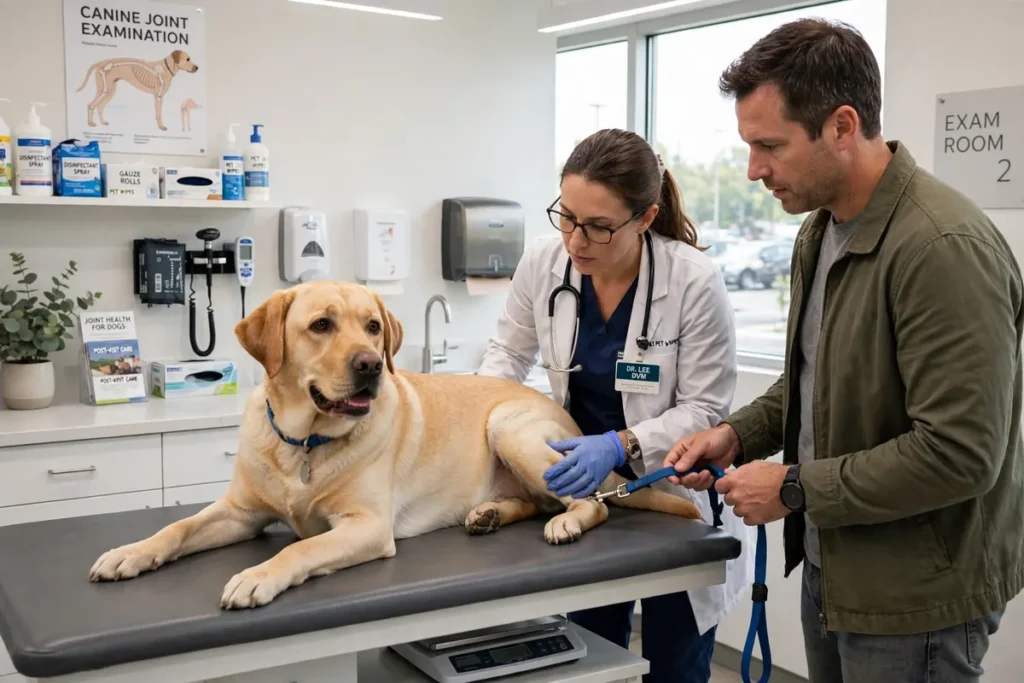
Cruciate ligament tears are the Lab’s most common big accident-style claim. The ligament that stabilizes the knee frays or snaps — often during an ordinary game of fetch — and the standard fix for an active Lab is TPLO surgery, which CareCredit’s 2026 veterinary cost analysis prices at an average of $3,525 (regional range $2,793–$6,417). Add X-rays, rehab, and follow-ups and MoneyGeek’s full-treatment range reaches $12,738. And knees come in pairs: a dog that tears one cruciate has a real chance of tearing the other later, which is why the waiting-period section below matters so much.
Two quieter genetic conditions deserve a mention even though they rarely produce giant bills. Exercise-induced collapse (EIC) is an inherited nerve-and-muscle condition: an affected young Lab wobbles and may collapse after intense play, then recovers with rest. There is no surgery and no cure — management is knowing your dog’s limits, and a DNA test can identify it early. Progressive retinal atrophy (PRA) slowly takes a Lab’s vision, usually starting between ages 3 and 9; it is painless and untreatable, and dogs adapt well, but eye exams along the way still cost money. Both conditions are on the AKC/OFA recommended DNA test panel for the breed — a reminder that a good breeder’s health testing is worth paying for up front.
Finally, the everyday stuff: ear infections (floppy ears plus a love of swimming is a recipe for them), skin allergies, and bloat — the deep-chested emergency where the stomach twists, which is always a race to the ER and a $2,500–$7,500 bill when you get there. None of these will ruin you alone. Together, across 11–13 years, they are the steady drip that the premium is really buying protection against.
The cruciate waiting-period trap (read this before you buy)
Here is the fine print no other Lab guide we found spells out. Most plans have waiting periods between enrollment and full coverage. For Labradors, one specific wait decides whether the breed’s most common big claim gets paid: the wait for cruciate ligament and orthopedic conditions. If your Lab tears a knee ligament during that window, the claim is denied — and worse, that knee is now pre-existing, so it stays excluded even after the wait ends. At many brands the other knee gets risky too, because a ligament problem on one side can be treated as a bilateral (both-sides) condition.
The waits vary enormously by brand. All four rules below were checked against the companies’ own pages and policy documents in October 2026:
Table: cruciate / orthopedic waiting periods at major brands
| Brand | Wait for knee & joint cover | Way to shorten it |
|---|---|---|
| Pumpkin | 14 days — the same short wait as everything else; no separate orthopedic wait | None needed |
| Embrace | 6 months for orthopedic conditions | Cut to 14 days with a vet orthopedic exam and a clear report card after you enroll |
| Fetch | 6 months for orthopedic conditions, incl. cruciate tears and hip dysplasia | Knee wait waived if a vet exam in the first 30 days documents healthy knees |
| Lemonade | 6 months for cruciate ligament events (30 days for other orthopedic conditions) | No waiver published |
For context, the longest wait on the market is Nationwide’s: about 12 months for knee injuries in most states. The practical lesson for a Lab owner is simple. Young Labs blow out knees in years 1–5, exactly when a 6-month wait is most likely to bite. If you choose a brand with a long orthopedic wait, do the waiver exam — at Embrace and Fetch, one vet visit in the first weeks of the policy can shrink a 6-month exposure to about 2 weeks. It is the highest-value vet visit you will ever book.
What to look for in a plan for a Labrador
Get accident-and-illness coverage, not accident-only. Accident-only plans skip illness entirely — and most Lab risk (dysplasia, cancer, allergies, EIC) is illness. Accident-only is a false economy for this breed.
Confirm hereditary conditions are covered. Hip dysplasia, elbow dysplasia, and PRA are inherited. Good plans cover hereditary conditions as standard; cheap ones sometimes exclude them. For a Lab, a plan that excludes hereditary conditions excludes the breed itself. Get the answer in writing.
Set the annual limit with the knee math in mind. One TPLO with rehab can run $4,000–$6,500 all-in; two knees in one year, or a knee plus a bloat emergency, can pass $12,000. A $5,000 limit is thin for this breed. $10,000 or unlimited is the level that actually transfers the risk.
Work one claim example before you buy. Say your Lab needs a $5,000 TPLO. With a $500 deductible and 80% reimbursement, the plan pays ($5,000 − $500) × 0.80 = $3,600, and you pay $1,400. Without a plan, you pay all $5,000 — plus the follow-up X-rays and rehab. Now picture the second knee. This arithmetic, not the monthly premium, is what you are shopping for. Our pet insurance statistics page shows how claim sizes like this play out across the whole market.
Check three smaller things: whether physical therapy/rehab is included (it matters after every joint surgery); whether exam fees are covered or cost extra; and whether the plan’s cruciate wait can be shortened with an exam, per the table above.
5 ways to pay less for Labrador insurance
1. Enroll as a puppy. Premiums start at their lifetime low (~$48/month, Insurify), nothing is pre-existing yet, and every waiting period is behind you before the high-risk knee years arrive. Our puppy insurance cost guide shows the puppy math across breeds.
2. Compare at least three quotes on identical settings. MoneyGeek found a $33–$129/month spread for the same Lab profile. Hold the settings constant ($500 deductible, 80% reimbursement, same annual limit) so you are comparing price, not coverage tricks.
3. Raise the deductible if you can truly cover it. Moving from $250 to $500 or $1,000 lowers the monthly premium meaningfully. Only do it if the deductible amount sits in your emergency fund — a deductible you can’t pay is a plan that fails exactly when you need it.
4. Take the waiver exam. If your chosen brand has a 6-month orthopedic wait, the Embrace/Fetch-style exam waiver doesn’t cut your premium — it cuts your risk, which is worth more. A tear in month 3 without the waiver costs you the whole surgery.
5. Ask about multi-pet discounts — and keep your Lab lean. Most insurers discount second pets (Pumpkin, for example, takes 10% off for each additional pet). And while no plan pays you to watch the food bowl, a lean Lab files fewer joint and weight-related claims over a lifetime — the cheapest claim is the one that never happens.
Our verdict: Labrador Retriever insurance costs about $56/month for a young adult — fair, mid-pack pricing for a breed whose risks are common, predictable, and occasionally very expensive. For most Lab owners it is worth it: lifetime premiums of roughly $7,000–$11,000 stand against a realistic worst case of two knee surgeries, a hip problem, or one bloat emergency that can match that on its own. Buy accident-and-illness coverage with hereditary conditions included, an annual limit of $10,000 or more, and the shortest cruciate waiting period you can get — then do the waiver exam if your brand offers one. Enroll in puppyhood, and the breed’s most famous bills become the insurer’s problem, not yours.
How we wrote this guide: every premium figure is labelled with its source where it appears — Forbes Advisor’s 2026 breed analysis, MoneyGeek’s and Insurify’s quote datasets, ValuePenguin’s cross-company averages, PetMD’s multi-company quotes, and Lemonade’s official breed page (the only brand that publishes a Labrador age curve). Treatment costs come from CareCredit’s 2026 veterinary cost analysis, MetLife’s published surgery cost guide, MoneyGeek’s vet-cost data, and Lemonade’s breed page. Waiting-period rules were checked against the brands’ own policy pages and documents (Pumpkin, Embrace, Fetch, Lemonade) in October 2026. Breed facts come from the AKC (size, lifespan, health testing) and University of Cambridge research published in Cell Metabolism (the POMC appetite gene). Premiums vary by ZIP code, age, and plan settings — get your own quotes before deciding. Last updated: October 2026.
Frequently asked questions
How much is pet insurance for a Labrador Retriever per month?
About $56/month for a 3-year-old on an accident-and-illness plan (Forbes Advisor’s 2026 analysis; $5,000 annual limit, $250 deductible, 80% reimbursement), or about $76/month with unlimited coverage. Puppies average ~$48/month and seniors ~$138/month (Insurify). ValuePenguin’s average across companies is $41.05/month on cheaper plan setups. Your ZIP code and settings move the number from there.
Is pet insurance worth it for a Labrador Retriever?
For most owners, yes. Labs are prone to exactly the kind of bills insurance exists for: TPLO knee surgery averaging $3,525 (CareCredit), hip replacement at $3,500–$7,000+ per hip, and bloat emergencies at $2,500–$7,500. Lifetime premiums run roughly $7,000–$11,000 — about the cost of one bad orthopedic year. It may not be worth it if you keep a deep, untouched emergency fund instead. The risky option is having neither.
What is the best age to insure a Labrador Retriever?
As a puppy — most brands enroll from 8 weeks old. Puppy premiums are the lowest of your dog’s life (~$48/month, Insurify), nothing is pre-existing yet, and you clear the long cruciate waiting periods before the active young-adult years when knee tears happen. Every year you wait, the starting price rises and the pre-existing list can only grow.
Does pet insurance cover cruciate ligament (ACL) surgery in Labs?
Yes, under an accident-and-illness plan — but timing rules decide real claims. Pumpkin covers knee injuries after its standard 14-day wait. Embrace, Fetch, and Lemonade impose a 6-month wait for cruciate/orthopedic conditions (Embrace and Fetch let you shorten it with an early vet exam). A tear that happens during the wait, or before you enroll, is pre-existing and won’t be covered — and at many brands it puts the other knee at risk under bilateral-condition rules.
Does pet insurance cover hip dysplasia in Labrador Retrievers?
Usually yes, if you enroll before any symptoms or diagnosis. Hip dysplasia is hereditary, so confirm your plan includes hereditary conditions, and expect orthopedic waiting periods (up to 6 months at some brands) to apply. If your Lab already limps, has been diagnosed, or has dysplasia noted in its vet records before you buy, that hip — and often both hips — will be excluded as pre-existing.
What is the cheapest way to insure a Labrador?
Compare at least three quotes with identical settings — MoneyGeek measured a $33–$129/month spread for the same Lab profile. Then raise the deductible to an amount you can genuinely pay, and take any multi-pet discount going. Be careful with accident-only plans: they are the cheapest quotes you will see, but they exclude the illnesses (dysplasia, cancer, allergies) that drive most Lab vet bills.
Can I get pet insurance for a senior Labrador?
Yes. Many brands enroll senior dogs with no upper age limit, though premiums are at their peak — about $138/month on average (Insurify), and PetMD’s quotes show roughly $160/month if you first enroll at age 10. Anything already diagnosed is pre-existing and excluded, so a senior plan protects against new problems — a knee tear, bloat, a swallowed sock — rather than the conditions your Lab already has.
How much does insurance cost for a Labrador puppy, and when can puppies enroll?
Most brands enroll puppies from 8 weeks old. Insurify’s quote data puts Lab puppy coverage at about $48/month, and PetMD’s multi-company quotes show $57/month for a puppy enrolled at 8 weeks. Enrolling at the first vet visit is the sweet spot: the price is at its lifetime low, the health record is clean, and waiting periods finish months before the boisterous, knee-risky young adult phase begins.
Sources
- PetPlace — Labrador Retriever pet insurance (Forbes Advisor 2026 analysis: $56/mo at $5,000 cover, $76 unlimited)
- MoneyGeek — Best pet insurance for dogs (6-year-old Lab benchmark: $61/mo average, $33–$129 range; vet-cost data)
- MoneyGeek — Fetch pet insurance review (Fetch at $70/mo on the benchmark Lab profile)
- ValuePenguin — Cheap pet insurance (Labrador cross-company average: $41.05/mo)
- Insurify — Full-coverage pet insurance cost (Lab puppy $48/mo, senior $138/mo)
- PetMD — Puppy insurance (Lab premiums by enrollment age: $57 at 8 weeks to $160 at 10 years)
- Lemonade — Labrador Retriever pet insurance (official age curve and condition costs)
- MetLife — Dog hip dysplasia surgery cost (FHO $1,200–$2,500; hip replacement $3,500–$7,000+ per hip)
- Pumpkin — Pet insurance waiting periods (14 days for all conditions incl. cruciate and hip dysplasia)
- Embrace — Orthopedic waiting periods (6 months, reducible with an orthopedic exam)
- Fetch — How pet insurance works (6-month orthopedic waiting period)
- Lemonade — After you buy (waiting periods: 6 months for cruciate ligament events)
- AKC — Is the Labrador Retriever right for you? (size 55–80 lb, life expectancy 11–13 years)
- University of Cambridge — The POMC gene variant behind Labrador appetite and weight (Cell Metabolism, 2016)