

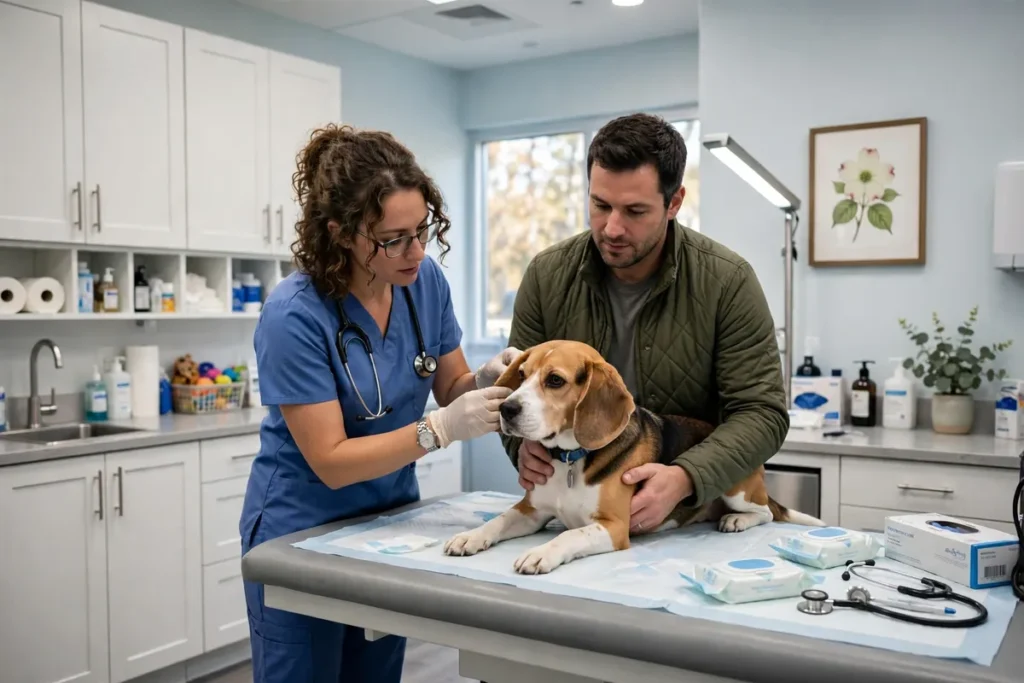
A dog owner in Richmond buys the cheapest plan she can find. Her beagle swallows a sock. Surgery costs $5,000. She thinks the hard part is over. Then the claim comes back short. Her plan paid 80 percent after a $500 deductible, so the claim came back $1,400 short. And Virginia law gave her no cooling off period, no cap on the waiting period, and no rule that made the insurer prove the problem was old. She had bought Virginia pet insurance, and the contract was the only protection she had.
She is not one person. Her story matches the complaints that show up again and again for Virginia owners. This guide starts with that trap, then gives you the numbers. Every price carries its source and recipe.
Short version: Virginia pet insurance runs about $43 to $73 a month for a dog and $21 to $39 a month for a cat on accident and illness cover. WSJ says $33 for dogs, but that is for a $5,000 limit only. Insurify says $73 for dogs, on a richer $10,000-plus limit plan. On the same $5,000 limit, ASPCA and Spot tie as cheapest for dogs at $22 a month. Virginia has not adopted the NAIC Pet Insurance Model Act, so there is no state-mandated free look period, no waiting-period cap, and no rule forcing an insurer to prove a condition was pre-existing. In Virginia, the contract is the whole protection.

The Trap Hiding in Plain Sight: Virginia Has No Pet Insurance Law
Most owners assume a state law backs them up. In Virginia, that assumption is wrong. Virginia has not adopted a pet insurance law based on the NAIC Pet Insurance Model Act, checked against the NAIC adoption chart for Summer 2026.
Three protections that owners in other states get by law do not exist here. First, the free look period. In a Model Act state, you get a set number of days to cancel a new policy and get your money back. Virginia sets no free look period for pet insurance. If your insurer gives you one, that is the insurer’s choice, not a right the state gave you. Ask for it in writing before you pay. Second, the waiting period cap. Virginia sets no cap. Most insurers wait 14 days for accidents and illnesses. Some wait 6 months for orthopedic problems, like knee and hip trouble. Figo waits 6 months for orthopedic conditions. Spot and ASPCA wait a flat 14 days for orthopedic conditions too. In Virginia, the contract decides the wait. The state will not shorten it for you. Third, pre-existing conditions. The Model Act puts the burden on the insurer to prove a condition was pre-existing before it can refuse cover. Virginia has no such rule. Spot and ASPCA will cover a curable condition again after 180 days with no symptoms and no treatment. Figo will cover one after 12 months. Chronic conditions, and knee problems in most cases, do not reset.
None of this means pet insurance in Virginia is unregulated. The Virginia State Corporation Commission’s Bureau of Insurance licenses insurers and agents, and it handles consumer complaints. Virginia Code 38.2-1800 sets out the line of authority for selling pet accident, sickness and hospitalization insurance. Check that the insurer is licensed with the Bureau. If a claim goes wrong, the Bureau is where you complain. Keep your policy, your vet records, and every claim letter. The watchers do not set the terms. The contract does.
The Price You Were Quoted Is Not the Price You Will Pay
Search for the cost of pet insurance in Virginia and you will find a mess. One page says $33 a month for a dog. Another says $43. Another says $66. Another says $73. Fetch says $38. PetPriority says $54 to $78. All of them can be right at the same time. They are measuring different plans. What decides the price is the limit, the deductible, and the reimbursement rate.
WSJ’s $33 for dogs and $15 for cats is the base model: a $5,000 annual limit, a $500 deductible, and 80 percent reimbursement, with rates from Wag. That is the cheapest tier WSJ priced. If your dog needs a $7,000 surgery, a $5,000 limit leaves a gap. Insurify’s $73 for dogs and $39 for cats is the richer car: a 2-year-old mixed-breed medium male dog and a 2-year-old American Shorthair female cat, at 80 percent reimbursement, a $500 deductible, and a $10,000-plus annual limit, with real-time quotes through Fletch. Same deductible, same reimbursement rate, but a limit at least twice as high. Of course it costs more.
Then there is the middle. Insurify’s national medians table, from June 2026 and based on more than 250,000 quotes, puts Virginia at $43 a month for dogs and $21 for cats. Petcosthub models Virginia at about $66 for dogs and about $34 for cats, from NAPHIA national averages times a Virginia factor of 0.95. Modeled is not quoted. Fetch says $38 for dogs and $26 for cats, with no profile stated at all. So which number should you trust? All of them, with the recipe attached. None of them, on its own. The honest Virginia dog range is $33 to $73 a month, and the honest cat range is $15 to $39. One small claim shows why the recipe matters more than the monthly price. Take a $300 vet bill, a $250 deductible, and 80 percent cover. The payout is $40: $300 minus $250 leaves $50, and 80 percent of $50 is $40. A cheap plan with a high deductible can pay almost nothing on small bills.
The Full Table: Virginia Prices, Reconciled
Here is every Virginia price this guide uses, with the source and the plan behind each row. Do not blend rows. Each figure belongs to its own recipe.
| Source | Dogs per month | Cats per month | Plan behind the figure |
|---|---|---|---|
| WSJ Buy Side, Virginia average | $33 | $15 | $5,000 limit, $500 deductible, 80% back, rates via Wag |
| WSJ Buy Side, ASPCA | $22 | $13 | Same $5,000 / $500 / 80% recipe |
| WSJ Buy Side, Spot | $22 | $12 | Same $5,000 / $500 / 80% recipe |
| WSJ Buy Side, Pumpkin | $23 | $13 | Same $5,000 / $500 / 80% recipe |
| WSJ Buy Side, MetLife | $37 | Not shown | Same $5,000 / $500 / 80% recipe |
| Insurify, Virginia average | $73 | $39 | 2-year-old mixed-breed dog, 2-year-old American Shorthair cat, 80% back, $500 deductible, $10,000-plus limit, quotes via Fletch |
| Insurify, Figo | $31 | $13 | Same Insurify profile |
| Insurify, Spot | $31 | $16 | Same Insurify profile |
| Insurify, Trupanion | $57 | $22 | Same Insurify profile |
| Insurify national medians, June 2026, Virginia | $43 | $21 | One-year rolling medians, 250,000-plus quotes, 10-plus insurers |
| petcosthub, Virginia average (modeled) | About $66 | About $34 | NAPHIA national averages times Virginia factor 0.95; dogs $58 to $74, cats $30 to $39 |
| petcosthub, accident-only (modeled) | About $15 | About $9 | Same modeled method; dogs $13 to $17, cats $8 to $10 |
| Fetch, own Virginia average | $38 | $26 | No profile stated on the page |
| Embrace, Virginia range | $20 to $70 | $10 to $30 | Existing policyholder averages; sample quotes on 70% back, $1,000 deductible, $5,000 limit |
| Pumpkin, Virginia from | $53 | Not stated | No profile stated on the page |
| PetPriority, Virginia typical | $54 to $78 | $27 to $41 | Adult mixed-breed in major metros |
On the cheap $5,000 limit, ASPCA and Spot tie as cheapest for dogs at $22 a month, and Spot is cheapest for cats at $12. WSJ gives both ASPCA and Spot its top score for Virginia, 5.0 stars each, with MetLife at 4.6 and Pumpkin at 4.4. Those are WSJ’s own scores, not a ClaimPaw verdict. On the richer $10,000-plus limit, the cheapest changes. Figo is cheapest at $31 a month for dogs and $13 for cats on Insurify’s Virginia quotes, tied with Spot at $31 for dogs. Trupanion is dearest of the three at $57 for dogs and $22 for cats. Trupanion is also different in kind: 90 percent reimbursement only, deductibles from $0 to $1,000, an unlimited limit, and direct pay to the vet.
The cheapest insurer in Virginia changes when the plan changes. Get three quotes on the same profile, and then compare. Our ASPCA vs Spot guide at ASPCA vs Spot runs the two WSJ Virginia winners head to head. For scale, NAPHIA’s 2026 report puts the average US premium at $836 a year for dogs and $435 for cats. Those are national figures, not Virginia figures.
Northern Virginia Prices Like DC, Roanoke Does Not
Virginia pet insurance is not one price. Northern Virginia prices like the DC metro. Richmond, Hampton Roads, and the Shenandoah Valley track closer to the national average. PetPriority says so, and the city tables back it up. Pawlicy gives the cleanest city split, because each range carries a stated recipe: 80 percent back, an unlimited limit, and a $500 deductible.
For a 6-month Chihuahua puppy, Virginia Beach runs $18 to $41 a month, Norfolk $19 to $37, and Richmond $19 to $72. For a 6-month Golden Retriever puppy, Virginia Beach runs $31 to $66, Norfolk $33 to $59, and Richmond $33 to $116. Richmond’s top end is the widest in every row.
Pumpkin gives single city figures with no profile behind them: Roanoke $33, Richmond $37, Norfolk $35, and Virginia Beach $44 a month for dogs. Use them as a second check, never as the quote. A local dog guide puts emergency surgery for a dog in Northern Virginia at $3,000 to $7,000, and a swallowed sock at about $2,000. If you live in Northern Virginia, price the plan against a $7,000 bill, not a $3,000 one.
The Age Trap: Your Puppy’s $47 Becomes $148
Age moves the price more than anything else in this guide. Pawlicy’s Virginia figures, on 80 percent back with an unlimited limit and a $500 deductible, put a puppy at $47.12 a month, a 5-year-old dog at $61.54, and a 10-year-old dog at $147.61. The senior costs more than three times the puppy. A kitten costs $27.05 a month, a 5-year-old cat $31.34, and a 10-year-old cat $73.01.
The trap is timing. Buy when the pet is young and healthy, and you lock in the low age band before anything gets diagnosed. Wait until the first limp or allergy flare, and the price is higher and the condition is now pre-existing, so the plan will not cover it.
The Breed Trap: Bulldogs Cost Double a Beagle
Breed is the second lever, and in Virginia it is a wide one. Petcosthub’s modeled breed table for Virginia shows the gap plainly. A Beagle costs $34 a month as a puppy, $39 as an adult, and $75 as a senior. A Bulldog costs $74 as a puppy, $87 as an adult, and $166 as a senior. The adult Bulldog costs more than double the adult Beagle. A French Bulldog runs $56, $66, and $126. A Labrador Retriever runs $40, $48, and $90. The cheapest dog on the table is a Chihuahua at about $33 a month as an adult. The cheapest cat is a Domestic Shorthair at about $25.
Those are petcosthub’s modeled estimates, not quotes. Use them to compare breeds, not to set your budget. If you own a Bulldog in Virginia, the breed trap has a second edge. Knee problems are common in heavy breeds, and knee problems are where waiting periods and pre-existing rules bite hardest. Figo waits 6 months for orthopedic conditions. Spot and ASPCA wait 14 days flat. Buy before the first limp, and the knee is covered after the wait. Buy after the limp, and it is pre-existing.
Virginia Hazards: Ticks, Rabies, Heatstroke and Snakes
Virginia’s hazards are not abstract. They are the claims Pumpkin lists as most common in the state: digestive issues, allergies, swallowed objects, and skin conditions, plus rabies and heatstroke. Add ticks, snakes, and wildlife bites, and you have the Virginia claim map. Ticks come first. Lyme disease and ehrlichiosis spread through tick bites. Tick-borne illness is covered as illness under accident and illness plans, once the waiting period has passed. Flea and tick prevention is not covered.
Rabies is second. Dogs and cats 4 months and older must receive a rabies vaccine. The vaccine itself is preventive, so the plan will not pay for it.
Heatstroke is third. Virginia summers are hot and humid, and heatstroke is a real risk for flat-faced breeds, heavy dogs, and any dog left in a car or exercised hard at midday. Snakes are fourth. Virginia is home to 32 snake species, including several venomous types. A snake bite is covered as an accident under most plans, once the waiting period has passed. Swallowed objects close the list. The beagle at the top of this guide swallowed a sock, one of the most common Virginia claims. Check that your plan covers swallowed objects.
The Worked Example: One $5,000 Emergency Bill, Three Ways
Take the beagle from the top of this guide. The sock is out. The bill is $5,000. That figure sits inside the Northern Virginia emergency surgery range of $3,000 to $7,000. Way one is the cheap plan: a $5,000 annual limit, a $500 deductible, and 80 percent back, the WSJ Virginia recipe. The bill minus the $500 deductible leaves $4,500. Eighty percent of that is $3,600. The insurer pays $3,600. You pay $1,400. The limit does not bite here, but it would bite on a $7,000 bill, where the payout would be cut to $5,000 by the cap.
Way two is the richer plan: an unlimited limit, a $500 deductible, and 90 percent back, the kind of plan Trupanion sells. The bill minus the deductible still leaves $4,500. Ninety percent of $4,500 is $4,050. The insurer pays $4,050. You pay $950. You save $450 against way one on this bill. Way three is accident-only cover, on the same $500 deductible and 80 percent rate, as a stated example rather than a quoted plan. A swallowed sock is an accident, so accident-only pays the same as way one on this bill: $3,600 back, $1,400 from you. But if the same $5,000 bill had been an illness, a tumor or an allergy crisis, accident-only would pay $0. That is the whole difference between the plan types. Accident-only is cheap, about $15 a month for dogs and about $9 for cats on petcosthub’s modeled Virginia average, because it covers about half the risk.
The deductible comes off the top, before the percentage. The limit matters most on the biggest bills, which are the bills you bought insurance for. A $15 plan that pays $0 on an illness is not cheaper than a $33 plan that pays $3,600. Our guide to how pet insurance works explains the plan types.

Which Plan Should You Pick
There is no best Virginia pet insurance plan for every owner. There is a best plan for your pet, your budget, and your ZIP code. Start with the situation, not the brand. If you have a puppy, buy accident and illness cover now, while the pet is young and healthy. The Pawlicy puppy price is $47.12 a month, and the wait is short. Pick a $5,000 limit if money is tight, and an unlimited limit if you can stretch to it. If you have a senior dog, run the math before you buy. At $147.61 a month for a 10-year-old, the premium alone is $1,771.32 a year. Check the exclusions twice, because anything already diagnosed is pre-existing, and in Virginia no law forces cover for it.
If you have several pets, ask about the multi-pet discount. Pumpkin offers 10 percent off for more than one pet. If you are a military family, check that cover follows a move to a new duty station. Embrace notes that its cover follows a move. Our military discount guide at military pet insurance discount lists the discounts by insurer, including Fetch at 10 percent for life and USAA and Embrace at up to 25 percent.
Whatever your situation, do these four things before you sign. Get three quotes on the same profile. Read the waiting period in writing, including the orthopedic wait. Read the pre-existing exclusion and the curable-condition reset, 180 days at Spot and ASPCA, 12 months at Figo. Check the insurer is licensed with the Virginia Bureau of Insurance. Premiums rise with age and vet costs, as our guide to whether pet insurance goes up after a claim shows. Budget for the climb.
Frequently Asked Questions
How much is pet insurance in Virginia?
About $43 to $73 a month for a dog and $21 to $39 a month for a cat on accident and illness cover. WSJ’s $33 for dogs is for a $5,000 limit only. Insurify’s $73 is for a richer plan on a 2-year-old mixed-breed dog. Your quote depends on your pet’s age, breed, ZIP code, deductible, limit and reimbursement rate.
What is the cheapest pet insurance in Virginia?
On WSJ’s Virginia table, ASPCA and Spot tie as cheapest for dogs at $22 a month, and Spot is cheapest for cats at $12 a month, all on a $5,000 limit with a $500 deductible and 80% reimbursement. On Insurify’s Virginia quotes, Figo is cheapest at $31 a month for dogs and $13 for cats. Compare three quotes on the same profile before you buy.
Is pet insurance worth it in Virginia?
It depends on your savings and your pet. A year of accident and illness cover for an adult dog costs about $794 in Virginia on petcosthub’s modeled average, while one emergency surgery in Northern Virginia can run $3,000 to $7,000. If a surprise bill that size would strain your budget, insurance turns it into a predictable monthly cost. If you can pay $5,000 out of pocket without worry, it may not be worth it.
Does Virginia have a pet insurance law?
No, not a pet insurance consumer law. Virginia has not adopted the NAIC Pet Insurance Model Act, so there is no state-mandated free look period, no cap on waiting periods, and no rule forcing an insurer to prove a condition was pre-existing before refusing cover. Pet insurers are still regulated by the Virginia State Corporation Commission’s Bureau of Insurance, which licenses carriers and handles complaints.
Is there a waiting period for pet insurance in Virginia?
Yes, and Virginia sets no cap on it, so the insurer’s contract decides. Most insurers wait 14 days for accidents and illnesses, and some wait 6 months for orthopedic conditions like knee and hip problems. Spot and ASPCA wait a flat 14 days for orthopedic conditions too. Figo waits 6 months for orthopedic conditions.
Does pet insurance cover pre-existing conditions in Virginia?
No, not while the condition is active, and Virginia law does not force insurers to cover them. Some insurers will cover a curable condition again after a symptom-free period, Figo after 12 months, Spot and ASPCA after 180 days. Chronic conditions and knee problems usually never reset. Enroll while your pet is young and healthy, before anything gets diagnosed.
What does pet insurance cost for a senior dog in Virginia?
A lot more than for a puppy. Pawlicy’s Virginia figures, on an 80% reimbursement rate with unlimited cover and a $500 deductible, put a puppy at $47.12 a month, a 5-year-old dog at $61.54, and a 10-year-old dog at $147.61. That is more than three times the puppy price.
Where do I complain about pet insurance in Virginia?
To the Virginia State Corporation Commission’s Bureau of Insurance, which regulates insurers in the state and handles consumer complaints. Confirm the insurer is licensed there before you buy, and keep your policy documents, vet records and claim letters, because the Bureau will ask for them.
Sources
- NAPHIA 2026 State of the Industry Report: US average $836 a year for dogs, $435 for cats. NAPHIA
- WSJ Buy Side, Best Pet Insurance in Virginia 2026: Virginia average $33 dogs, $15 cats; ASPCA and Spot $22 dogs. WSJ Buy Side Virginia
- Insurify, Best Pet Insurance in Virginia (2026): Virginia average $73 dogs, $39 cats; Figo $31, Spot $31, Trupanion $57 dogs. Insurify Virginia
- petcosthub, Pet Insurance Cost in Virginia: modeled average about $66 dogs, about $34 cats, factor 0.95, breed table, accident-only figures. petcosthub Virginia
- Fetch, Pet Insurance in Virginia: own average $38 dogs, $26 cats. Fetch Virginia
- Pawlicy, Virginia by age and city: puppy $47.12, 5-year-old $61.54, 10-year-old $147.61 a month; Virginia Beach, Norfolk and Richmond ranges. Pawlicy Virginia
- Embrace, Pet Insurance in Virginia: ranges $20 to $70 dogs, $10 to $30 cats. Embrace Virginia
- Pumpkin, Pet Insurance in Virginia: from $53 dogs; Roanoke $33, Richmond $37, Norfolk $35, Virginia Beach $44. Pumpkin Virginia
- NAIC Model Act adoption chart, Summer 2026: Virginia has not adopted a pet insurance law based on the Model Act. Virginia pet insurance law
- Virginia Code 38.2-1800: pet accident, sickness and hospitalization insurance authority. Virginia Code 38.2-1800
- Virginia State Corporation Commission, Bureau of Insurance: licensing and consumer complaints. Bureau of Insurance
- DogFriendlyNoVA: emergency surgery $3,000 to $7,000, swallowed sock about $2,000. DogFriendlyNoVA
- PetPriority, pet insurance cost by state: Virginia typical $54 to $78 dogs, $27 to $41 cats. PetPriority