

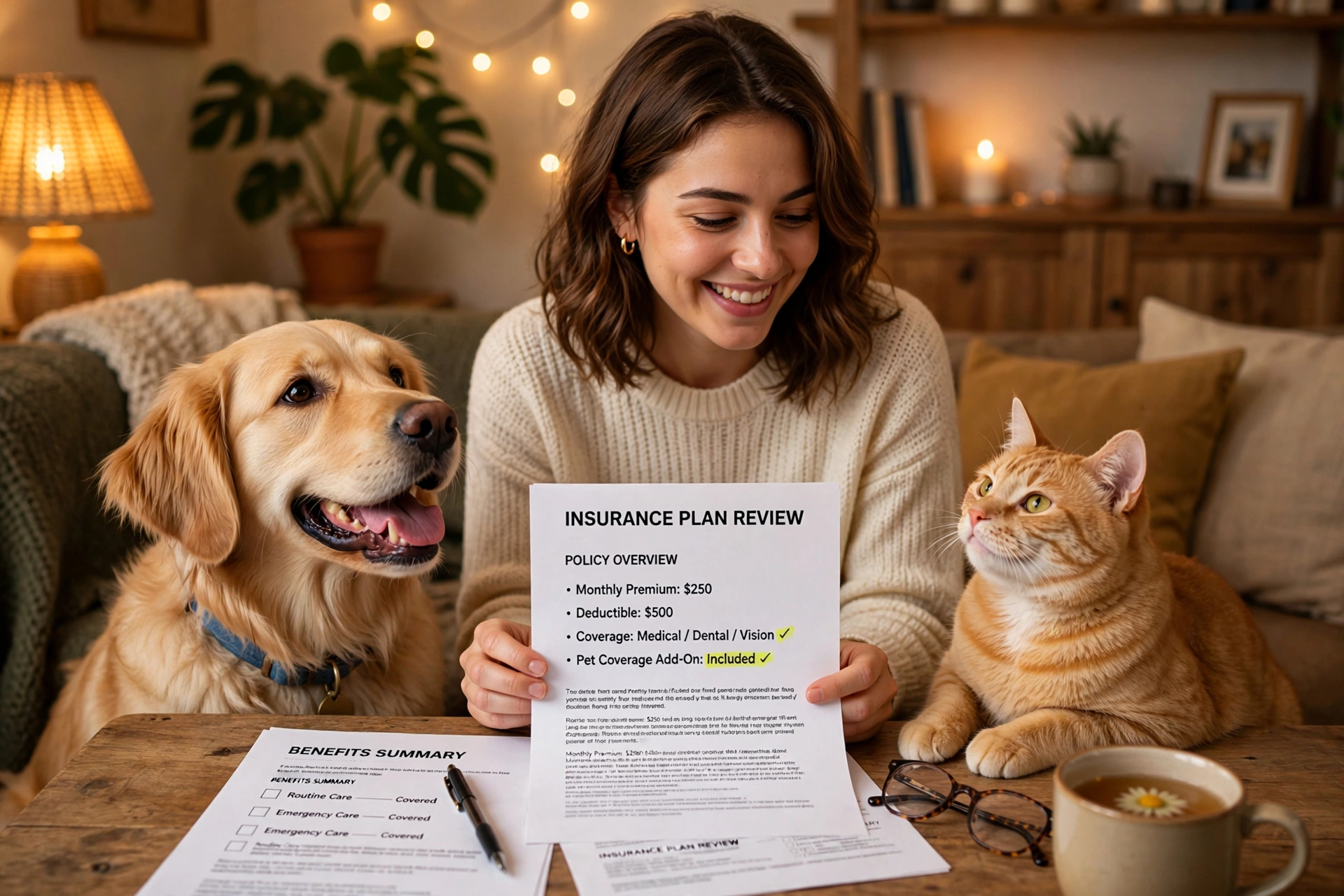
TL;DR: There are 3 types of pet insurance plans: accident-only (about $193/year for dogs), accident & illness (about $749/year for dogs), and wellness add-ons ($10–$60/month extra). Accident-only covers injuries. Accident & illness covers injuries plus sickness. Wellness covers routine care like vaccines. (NAPHIA 2024 averages via Parade, 2026-10-09.)
Shopping for pet insurance gets confusing fast. Every company uses slightly different words for the same ideas — but underneath the marketing, the types of pet insurance plans come down to just three options. Learn those three, and every quote you see will make sense.
Key Takeaways
- There are three types of pet insurance plans: accident-only (about $193/year for dogs), accident & illness (about $749/year), and wellness add-ons ($10–$60/month extra).
- Accident & illness is the standard plan most owners buy — and the one vets recommend most — because illness is where the biggest bills hide.
- A wellness plan is not insurance: it never covers emergencies, and the average dog owner breaks even or loses $50–$150 per year on one versus paying out of pocket.
- Accident-only fits tight budgets (real plans from $9/month, waiting periods of 0–15 days), pre-existing illness cases, and seniors with limited options — and ASPCA is the only major insurer letting you bolt wellness onto accident-only.
Table of Contents
What Are the 3 Types of Pet Insurance Plans?
The 3 types of pet insurance plans are accident-only, accident & illness, and wellness add-ons. Accident-only pays for injuries like broken bones. Accident & illness — the standard plan — pays for injuries plus sickness like infections and cancer. Wellness add-ons pay for routine care like vaccines and checkups. Most owners pick accident & illness.
Accident-only is the budget option. It pays when your pet gets hurt in a sudden event — a broken leg, a bite wound, something swallowed that should not have been. Nothing else. It is the cheapest way to carry real protection against a surprise ER bill.
Accident & illness is the standard plan most owners buy. It covers everything accident-only covers, plus sickness: infections, allergies, digestive problems, cancer, and long-term conditions like arthritis or diabetes. Insurers often call this “comprehensive” coverage.
Wellness add-ons are not insurance at all. They are a routine-care package you bolt onto one of the two real plans. They reimburse checkups, vaccines, and flea prevention. Think of them as a budgeting tool, not protection.
One quick note on words: “comprehensive” is just the industry’s nickname for accident & illness — not some fourth mystery option. When owners compare accident-only vs comprehensive coverage, the real question is simple: how much illness risk can you afford to carry yourself?
What Does Accident-Only Pet Insurance Cover — and What Does It Miss?
Think of accident-only as emergency-room-only coverage: it pays for injuries from sudden events — broken bones, bite wounds, swallowed objects, car accidents. Illness is never covered. No infections, no allergies, no cancer, no chronic disease. Routine care is out too.
Covered, typically: fractures, lacerations, bite wounds, swallowed objects, car accidents, accidental poisoning — sudden injuries, in other words.
Not covered, ever: any illness — infections, allergies, cancer, diabetes, arthritis — plus all routine care and pre-existing conditions.
Two honest facts. First, accident-only starts fast — waiting periods run 0–15 days (WSJ Buyside, 2026-06), so coverage kicks in within weeks. Second, most vet spending is not accidents: of Nationwide’s ten most common claims, only 2 in 10 dog claims were accident-related, while 5 in 10 were chronic illnesses (Kiplinger, ~2025-09). It is cheap because it skips where most of the money goes.

So who is it actually good for? MoneyGeek’s 2026 accident-only guide names four cases: pets with higher accident risk, pets whose illnesses are already excluded as pre-existing, owners who want budget protection against one big ER bill, and senior pets with fewer comprehensive options (MoneyGeek, 2026-09). Say your puppy swallows a sock — that is classic accident-only territory. If any of those sound like you, accident-only is a smart floor — far better than nothing.
What Does ‘Comprehensive’ Accident & Illness Insurance Really Include?
Accident & illness is the plan most owners buy — and the one vets recommend most. It covers injuries plus almost all sickness: infections, allergies, digestive trouble, cancer, and chronic conditions like arthritis and diabetes. Pre-existing conditions and routine care stay excluded.
Specifically, a standard plan pays for all accidents plus infections, allergies, skin and ear problems, digestive trouble, cancer treatment, and chronic conditions like arthritis and diabetes — as long as they appear after you enroll and the waiting period ends.
Still excluded: pre-existing conditions, routine wellness care, breeding, and cosmetic procedures — standard across the industry.
Why do most owners land here? Because illness is where the big money hides. Remember the Nationwide numbers: 5 of 10 dog claims and 6 of 10 cat claims were chronic conditions (Kiplinger, ~2025-09). From $800 ER visits to $15,000 cancer treatments, accident-only leaves all of that on you — the cost section below puts exact numbers on each.
Your deductible and reimbursement choices shape the monthly price of this plan more than anything else — our deductible explainer walks through that math with real claim examples.
How Do Wellness Plans and Routine-Care Add-Ons Work?
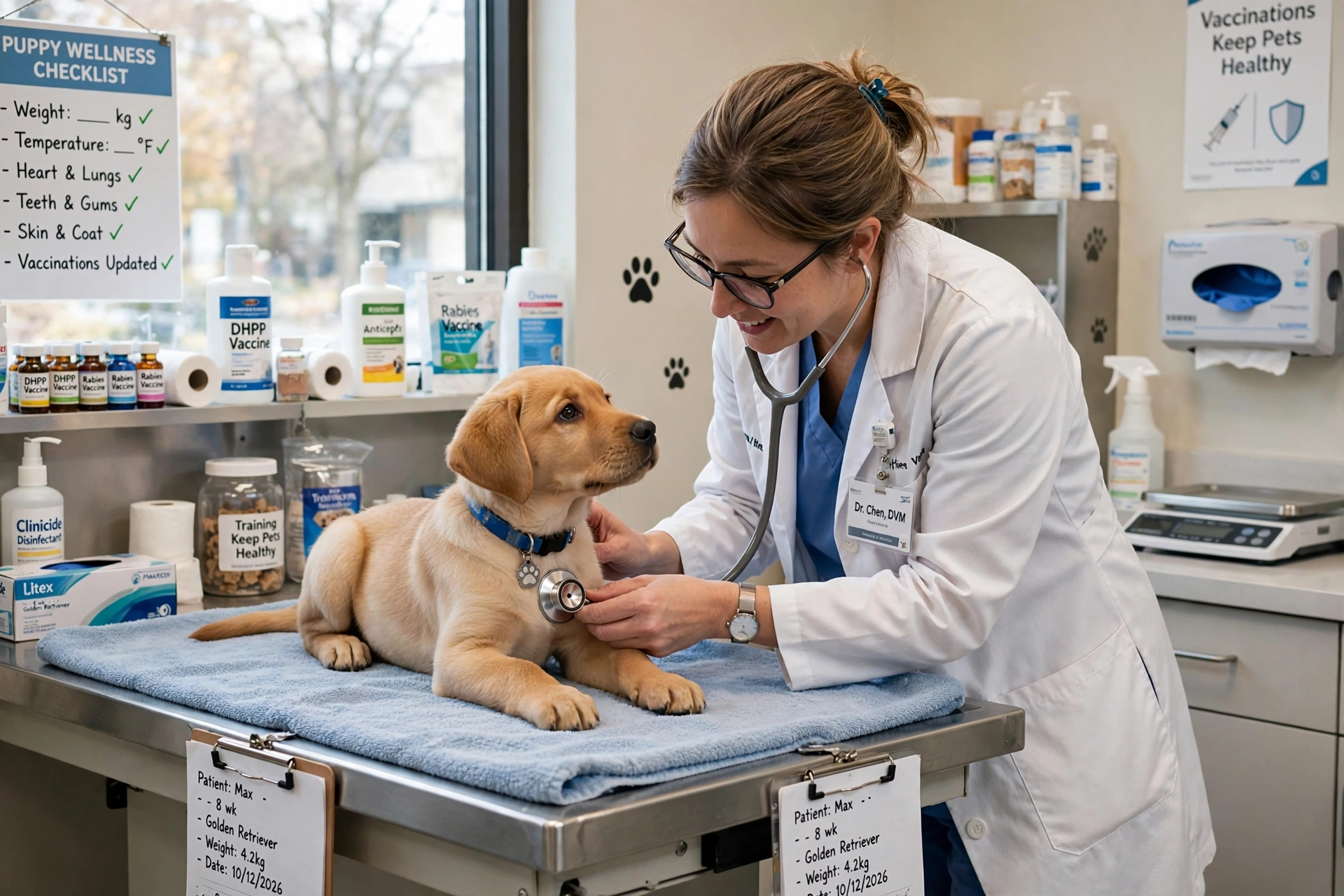
Here is the key distinction: a wellness plan is not insurance. It is a routine-care add-on you bolt onto one of the two real plans — it reimburses annual exams, vaccines, flea prevention, and sometimes dental cleanings or spay/neuter. It never covers accidents, illness, or emergencies. You usually add it at sign-up or renewal, not mid-year.
You pay extra each month — typically $10–$60 (TheVetDesk, 2026-01) — and the plan reimburses set amounts per service: say $50 toward the annual exam, $75 toward vaccines. Real examples: Spot $9.95/month, Lemonade $17.95/month (3-year-old mixed breed), Wagmo $20–$59/month tiered (TheVetDesk, 2026-01; WSJ Buyside, 2026-09-11). Yearly: $168–$600 (Money.com).
The fine print matters more here than anywhere else:
- Timing: you can usually add wellness at sign-up or policy renewal — typically not mid-policy year (alldogsthings.com, 2026-01).
- Eligibility caps: Lemonade cuts off wellness eligibility at age 2; Embrace at age 14 (WSJ Buyside, 2026-09-11). Enroll young if you want it.
- The ASPCA exception: ASPCA is the only major insurer that lets you bolt a wellness plan onto an accident-only policy (Canine Journal, 2026-10). Everyone else requires the accident & illness base plan first.
- AKC’s simpler version: AKC’s wellness add-ons carry no waiting periods, deductibles, coinsurance, or annual limits (akcpetinsurance.com) — rare in this corner of the market.
- What it never does: cover emergencies. The WSJ’s explicit list rules out accidents, injuries, illnesses, chronic disease, and emergencies entirely (WSJ Buyside, 2026-09).
Wellness plans are budgeting tools, not safety nets. Keep that sentence in your head while shopping. For a deeper look at how the add-on model is supposed to function, Spot’s wellness explainer lays out the mechanics from the provider side.
How Much Does Each Plan Type Cost?
Let us talk dollars. Accident-only averages $193 per year for dogs and $110 for cats (NAPHIA 2024 via Parade, 2026-10-09), with real plans from $9/month for dogs. Accident & illness averages $749 per year for dogs and $386 for cats. Wellness add-ons cost $10–$60 per month on top of insurance, or $168–$600 per year.
The table below puts it all in one place — 2026 figures, dogs first since most quotes are written for dogs:
Table: Pet insurance plan types — 2026 cost and coverage comparison
| Accident-only | Accident & illness | Accident & illness + wellness add-on | |
|---|---|---|---|
| Typical yearly cost (dogs) | ~$193/yr avg; plans from $9/mo (Pets Best flyer, 03/2025) | ~$749/yr avg (NAPHIA 2024 via Parade, 2026-10-09) | ~$749/yr + $168–$600/yr add-on (Money.com) |
| Typical yearly cost (cats) | ~$110/yr avg (NAPHIA 2024 via Parade, 2026-10-09) | ~$386/yr avg (NAPHIA 2024 via Parade, 2026-10-09) | ~$386/yr + $168–$600/yr add-on (Money.com) |
| Accidents | Yes | Yes | Yes |
| Illness | No | Yes | Yes |
| Chronic / hereditary conditions | No | Yes, if new after enrollment | Yes, if new after enrollment |
| Routine care (vaccines, checkups) | No | No | Yes |
| Emergencies | Yes, accident-related | Yes | Yes |
Averages hide real spread — your quote moves with breed, age, and zip code, as the national average cost of pet insurance breaks down.
The money protects against real stakes: ER visits run $800–$1,500, complex emergencies reach $3,000–$5,000 (Bankrate 2025, CareCredit 2024, via BestiePaws), and cancer treatment can exceed $15,000 (lifescarousel.com, 2026-09-17). Sniffspot’s worth-it analysis puts it plainly: one bad night can cost more than years of premiums.
Which Plan Type Is Best for My Pet?
There is no universal winner here — the best plan type matches your situation. Tight budget? Accident-only from $9/month beats nothing. Most owners? Accident & illness, since most vet bills come from illness, not accidents. Planner who uses every vet visit? Add wellness. Answer four quick questions below to land on yours.
1. How tight is your monthly budget? If $50+/month is a stretch, accident-only from $9/month (Pets Best, 03/2025 flyer) gives you catastrophe protection for the price of two coffees. Something beats nothing — always.
2. How old and healthy is your pet? Young, healthy pets face mostly accident risk, so accident-only plus a small savings buffer is defensible — but illness risk climbs every year, which is why accident & illness is the adult-pet default.
3. Could you handle a $5,000 surprise bill? If that number makes your stomach drop, you want accident & illness. Insurance exists for bills you cannot comfortably absorb, and $5,000–$10,000 surgeries are the textbook case.
4. Will you actually use routine care? Wellness only pays if you show up. If you reliably do annual exams, vaccines, and prevention every year, run the break-even math below. If you tend to skip vet visits, skip wellness too — unused benefits are just a donation to the insurer.
Table: Which pet insurance plan type fits your situation (2026)
| Your situation | Recommended plan type | Why |
|---|---|---|
| Tight budget, any pet | Accident-only (from $9/mo) | Cheapest real protection; covers the ER bills that bankrupt owners |
| Healthy puppy or kitten | Accident-only + savings, or accident & illness | Puppies face accident risk; the vaccine series is predictable enough to budget |
| Typical adult dog or cat | Accident & illness | Most claims are illness/chronic (Nationwide via Kiplinger, 2025-09) — this is where the money goes |
| Pet with pre-existing illnesses | Accident-only | Comprehensive plans exclude existing conditions anyway; cover the accidents (MoneyGeek, 2026-09) |
| Planner who never misses vet visits | Accident & illness + wellness add-on | Break-even math can work if you use every covered service |
| Senior pet, few comprehensive options | Accident-only | Some insurers limit new enrollment by age; accident cover stays available (AAHA, 2026-09) |
Prices also shift by state — what pet insurance costs in Texas shows how much city and breed move the numbers in one state.
What’s the Trap to Avoid With Wellness-Only Plans?
The trap is the name itself. A wellness plan sounds like insurance, but it is not. It pays for checkups and vaccines while covering zero accidents, zero illness, and zero emergencies — exactly the bills that bankrupt owners. Some 12-month contracts even keep billing after a pet dies (Clark.com). Never buy wellness as your only protection.
This confusion is common enough that Google’s own “people also ask” box fields the question: “Is a pet plan the same as insurance?” The answer is no, and the difference costs real money when owners learn it at the ER.
Here is how the trap usually springs. A vet chain or pet store sells you a “wellness plan” for $30–$80/month (Banfield’s range for dogs, via BestiePaws). It feels like coverage. Then your dog tears a ligament — a $3,000–$5,000 bill — and you discover the plan pays exactly $0 toward it, because the WSJ’s explicit exclusion list bars accidents, injuries, illnesses, and emergencies from wellness plans (WSJ Buyside, 2026-09).
Two more gotchas buried in the fine print. First, the break-even math is brutal: the average dog owner breaks even or loses $50–$150 per year on a wellness plan versus just paying out of pocket (alldogsthings.com, 2026-01). You have to use nearly every covered service to come out ahead. Second, check the cancellation terms before you sign anything annual — 12-month lock-ins are common at vet chains, and getting out early can cost you.
The safe way to buy wellness: only as an add-on to real insurance, and only after doing the math on services you will genuinely use. Remember the ASPCA exception too — it is the one major insurer that lets you pair wellness with a cheap accident-only base (Canine Journal, 2026-10), which can be the lowest-cost way to get both.
Frequently Asked Questions
Is a pet plan the same as insurance?
No. A wellness plan pays for routine care — checkups, vaccines, flea prevention. Real pet insurance pays for the unexpected — accidents, illness, and emergencies. They are different products sold with confusingly similar names. A wellness plan never covers a $5,000 surgery; insurance never covers a $50 vaccine visit.
What are the four types of pet insurance?
There are really three: accident-only, accident & illness, and wellness add-ons. The “fourth type” people ask about is usually wellness counted as its own category, or confusion with deductible structures (annual vs per-condition). In the US market, every policy is one of the three — or a bundle of them.
Is accident-only pet insurance worth it?
It is worth it in four cases: your budget is tight, your pet faces high accident risk, pre-existing illnesses are already excluded from comprehensive cover, or your senior pet has fewer comprehensive options (MoneyGeek, 2026-09). The honest caveat: only 2 in 10 dog claims are accident-related (Nationwide via Kiplinger, 2025-09), so know what you are skipping.
Are pet wellness plans worth it?
Sometimes — if you do the math first. The average dog owner breaks even or loses $50–$150 per year versus paying out of pocket (alldogsthings.com, 2026-01). They make the most sense for puppies needing a full vaccine series (spotpet.com, 2026), or owners who reliably use every covered service. If you skip vet visits, skip the plan.
Can I add a wellness plan later?
Usually at policy renewal — typically not in the middle of a policy year (alldogsthings.com, 2026-01). So if you think you will want wellness, plan for it at sign-up or at your next renewal date. Check your insurer’s specific rules, since a few handle timing differently.
Do wellness plans cover emergencies?
No — never. Wellness plans cover routine, predictable care only. The WSJ’s explicit exclusion list bars accidents, injuries, illnesses, chronic disease, and emergencies from wellness coverage (WSJ Buyside, 2026-09). If emergency protection is what you want, you need real insurance.
What is the cheapest type of pet insurance?
Accident-only, by a wide margin. Real plans start from $9/month for dogs and $6/month for cats (Pets Best flyer, 03/2025), and the national average is about $193/year for dogs (NAPHIA 2024 via Parade, 2026-10-09). It covers injuries only — but for tight budgets, it beats going uninsured.
Does pet insurance cover all your pets or just one?
Just one — each pet needs its own policy and its own premium. You cannot put two dogs on a single plan the way you might bundle cars. Insuring a second pet means a second policy, though many companies offer multi-pet discounts when you cover the whole household.
The bottom line: the types of pet insurance plans come down to three choices — accident-only for the budget-conscious, accident & illness for most owners, and wellness add-ons for routine-care planners. Match the plan to your pet’s real risks, not the marketing. And whatever you pick, read what it excludes before you need it — that is where cheap plans quietly become expensive.
Disclosure: Figures in this article come from published sources dated 2026, noted where they appear. Premiums vary by breed, age, location, and plan details — get your own quotes before deciding. This article covers the money side of pet insurance only; for health questions, confirm with your veterinarian.
11 thoughts on “Types of Pet Insurance Plans Explained (2026): Accident-Only vs Accident & Illness vs Wellness”